
The three models at a glance
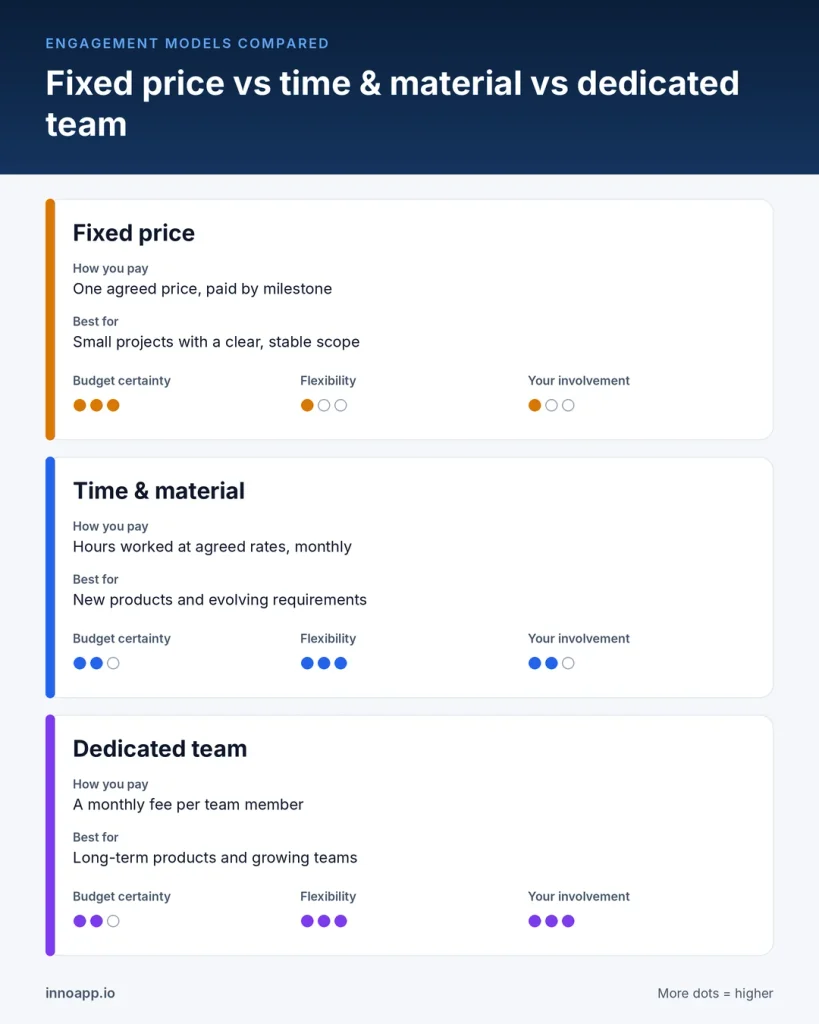
The models trade predictability for flexibility. Fixed price locks the budget but not much else can move; time and material and dedicated teams let scope change but need closer involvement from you.
| Factor | Fixed price | Time and material | Dedicated team |
|---|---|---|---|
| How you pay | One agreed price, usually by milestone | Hours worked at agreed rates, billed monthly | A monthly fee per team member |
| Scope | Fixed and fully defined upfront | Can change every sprint | Can change; you own the backlog |
| Budget predictability | High | Medium (higher with a monthly cap) | High per month, open overall |
| Flexibility | Low | High | High |
| Who runs day-to-day work | The vendor | Shared | You (the vendor handles hiring and admin) |
| Your time needed | Low after sign-off | Medium: regular reviews | High: you need a product owner |
| Typical length | 1 to 6 months | 3 to 12 months | 12 months or more |
| Biggest risk | Scope gaps and change requests | Hours and scope drifting | Paying for idle capacity |
| Best for | MVPs and small, well-defined projects | Evolving products and agile work | Long-term products and growing teams |
All three are common. In the GoodFirms 2026 survey of 100+ software companies, 81% offered time and material, 66% fixed price and 59% dedicated teams.
Fixed price model
In a fixed price contract, you and the vendor agree on a detailed scope, a delivery date and a total price before work starts. The vendor carries the risk of going over budget, so the price usually includes a buffer for that risk. Any change to scope becomes a separate change request with its own cost.
How it works: a discovery or requirements phase produces a detailed specification. The vendor quotes against it, then delivers in milestones, and you pay as each milestone is accepted.
Pros
- You know the total cost and deadline upfront
- Little day-to-day management needed from you
- Easy to get budget approval
Cons
- Every change means a change request, which slows things down and adds cost
- Writing a complete specification upfront takes time and is hard for new products
- The risk buffer in the price means you may pay more than the work actually costs
- The vendor has an incentive to deliver exactly what was written, not what users need
Best for: MVPs, proofs of concept, website builds and small projects with clear, stable requirements. Scope changes are common even in well-planned projects: GoodFirms found that scope creep typically adds 10–25% to project costs.
Time and material model
In a time and material (T&M) contract, you pay for the hours the team actually works at agreed rates, plus any agreed costs such as tools or licences. Scope can change from sprint to sprint, so you can react to user feedback and new priorities without renegotiating the contract.
How it works: you agree on rates per role and a rough estimate. The team works in short sprints, and you review progress, reprioritize and approve timesheets every week or two.
Pros
- Full flexibility to change features and priorities
- Work can start quickly, without a complete specification
- You pay only for work actually done, with no risk buffer built in
- Full visibility into hours, progress and costs
Cons
- The final cost is not fixed, which makes budgeting harder
- You need to stay involved to review work and set priorities
- Without controls, hours and scope can drift
Best for: new products, agile development, projects where requirements are still being discovered and ongoing improvements after launch. A monthly budget cap and a clear backlog keep costs under control.
Dedicated team model
In a dedicated team model, the vendor assembles a team (developers, QA, designers, a project manager as needed) that works only on your product, full time and long term. You pay a fixed monthly fee per team member. The vendor handles hiring, payroll, office and admin, while you set priorities and direct the work.
How it works: you agree on the team’s size and roles. The vendor recruits or assigns the people, onboards them to your product and replaces anyone who leaves. You can add or remove people with agreed notice.
Pros
- A stable team that builds deep knowledge of your product over time
- Predictable monthly cost
- Full control over priorities, like an in-house team
- Easy to scale up or down as the roadmap changes
- No hiring, HR or office costs on your side
Cons
- You need a product owner or tech lead who can direct the team
- You pay for the team’s capacity, even in quieter weeks
- Setting up the team takes a few weeks
- Not cost-effective for short projects
Best for: long-term product development, SaaS platforms, companies scaling their engineering capacity and products that need continuous updates after launch.
How to choose the right model
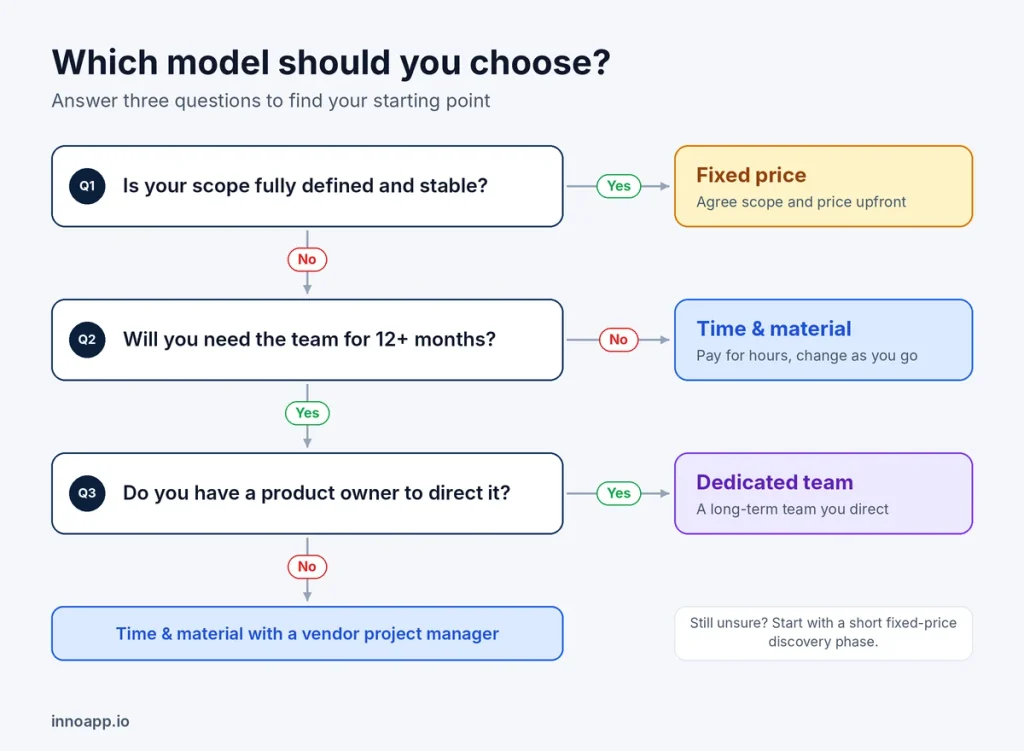
Three questions settle most decisions:
- How clear and stable is your scope? If every feature is defined and unlikely to change, fixed price works. If you expect to learn and adjust, choose time and material or a dedicated team.
- How long will you need the team? Under six months points to fixed price or time and material. A year or more of continuous work points to a dedicated team.
- Who will manage the work day to day? If you have no product owner with time to spare, fixed price puts management on the vendor. If you do, time and material or a dedicated team gives you more control.
| Your situation | Best model |
|---|---|
| An MVP or prototype with a short, clear feature list | Fixed price |
| A strict budget that cannot be exceeded | Fixed price, or time and material with a hard cap |
| A new product where you expect to learn from users | Time and material |
| Ongoing features and fixes on an existing product | Time and material or dedicated team |
| A product you will build and grow for years | Dedicated team |
| You need to scale engineering capacity quickly | Dedicated team |
| You are not sure about scope yet | Fixed-price discovery phase, then time and material |
Hybrid models: getting the best of both
You don’t have to pick just one. Many projects combine models to balance budget control with flexibility.
- Fixed-price discovery, then time and material. A short fixed-price phase (often 2 to 6 weeks) produces requirements, designs and an estimate. Development then runs on time and material, with far less guesswork.
- Time and material with a cap. You keep the flexibility of T&M, but agree a monthly or total ceiling the vendor cannot exceed without your approval.
- Milestone-based payments. Work is billed by the hour, but payments are tied to agreed deliverables. In the GoodFirms survey, 69% of software companies offered milestone-based payments, making it the most common payment term.
- Fixed-price MVP, then a dedicated team. Launch a small, well-defined first version on a fixed price, then move to a dedicated team to grow the product.
What to put in the contract
Whichever model you choose, a clear contract prevents most disputes. Every contract should cover IP ownership, confidentiality, security, warranty and an exit clause. Each model also needs a few specific terms.
| Model | Must-have contract terms |
|---|---|
| Fixed price | A detailed statement of work, acceptance criteria for each milestone, a change-request process with pricing, and a warranty period for bug fixes |
| Time and material | Rates per role, a monthly cap or approval threshold, timesheet and reporting rules, and the right to review the team’s seniority |
| Dedicated team | Named team members and roles, the process and notice period for scaling up or down, replacement time if someone leaves, and the minimum commitment period |
How InnoApp works with you
InnoApp Software Systems is a product engineering company based in Chennai, India. We help enterprises design, build and scale products across mobile, cloud, IoT and enterprise applications, and we recommend the engagement model that fits your scope rather than the one that suits us.
- Fixed price for well-defined MVPs, prototypes and modules
- Time and material for evolving products and ongoing product engineering work
- Dedicated teams for long-term development across cloud engineering, business applications, mobile and IoT
[Confirm before publishing]: that InnoApp offers all three models, plus any standard terms worth mentioning (for example a free discovery call, minimum team size or notice period).
FAQs
What is the difference between fixed price and time and material?
With fixed price, you agree the scope and total cost before work starts, and changes need change requests. With time and material, you pay for the hours actually worked, and scope can change as the project goes.
Which is cheaper: fixed price or time and material?
Fixed price looks safer, but the quote usually includes a buffer for the vendor’s risk. Time and material often costs less for well-run projects, because you pay only for work done. For poorly controlled projects, time and material can cost more.
What is a dedicated team model in software development?
It is a long-term arrangement where a vendor provides a team that works only on your product. You pay a monthly fee per person and direct the work, while the vendor handles hiring, payroll and admin.
Is a dedicated team the same as staff augmentation?
They are similar. Staff augmentation usually adds individual engineers to your existing team. A dedicated team is a complete unit, often with its own project manager and QA, that works on your product as a whole.
Can I switch models during a project?
Yes, and it is common. Many companies start with a fixed-price discovery phase or MVP, then move to time and material or a dedicated team once the product direction is clear.
Which model is best for agile development?
Time and material or a dedicated team. Both let you reprioritize each sprint, which is what agile development needs.