What Is Custom ERP vs Off-the-Shelf ERP?
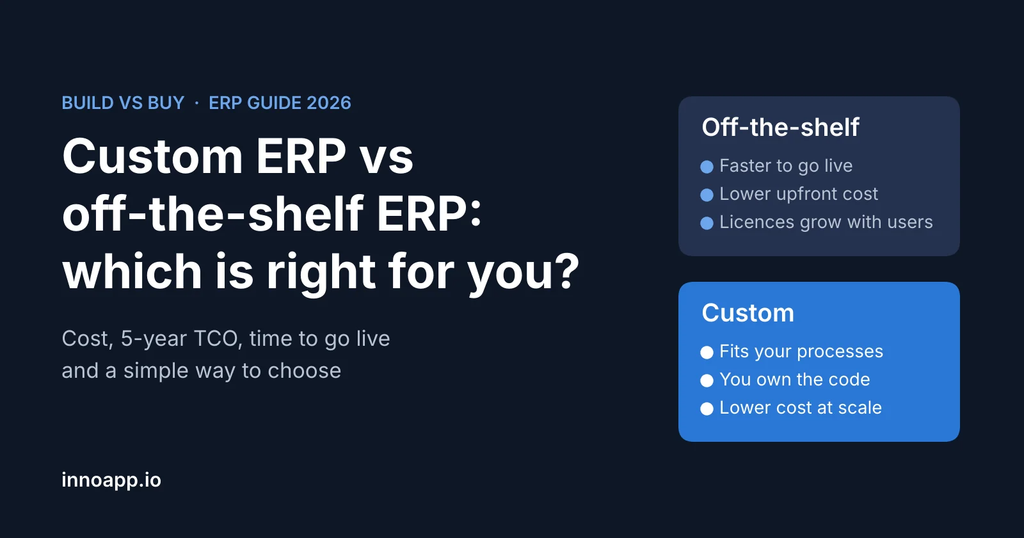
Custom ERP is enterprise resource planning software built specifically for one company’s processes, which the company owns. Off-the-shelf ERP is a ready-made product, such as SAP Business One, Microsoft Dynamics 365 or Odoo, licensed to many companies and configured to fit. The trade-off is fit and ownership versus speed and upfront cost.
Both cover the same ground: finance, inventory, purchasing, sales, production and reporting. The difference is who shapes the software. With off-the-shelf ERP, you adapt your processes to the product. With custom ERP, the product is built around your processes.
Custom ERP vs Off-the-Shelf ERP: Side-by-Side Comparison
Off-the-shelf wins on speed and upfront cost. Custom wins on fit, ownership and cost as you grow.
| Factor | Custom ERP | Off-the-shelf ERP |
|---|---|---|
| Upfront cost | Higher: about ₹15 lakh to ₹2 crore+ to build, depending on scope | Lower: licences plus implementation, often ₹10–40 lakh for an SME |
| Ongoing cost | Hosting, plus 10–20% of the build cost a year for maintenance | A per-user subscription every year, plus partner support |
| Time to go live | 4–6 months for a first set of modules; 9–12 months for a full system | 3–6 months for a typical SME rollout |
| Fit to your processes | Exact, because it is built around them | Good for standard processes; gaps need workarounds or extensions |
| Cost as you add users | Barely changes | Rises with every licence |
| Upgrades | You decide when and what | On the vendor’s schedule; heavy customisation can break on upgrade |
| Ownership | You own the code and the data | You own the data; the vendor owns the product |
| Vendor lock-in | Low, if you receive the source code and documentation | Higher; switching means a new implementation |
| Machines, IoT and legacy systems | Integrated to order | Through connectors or APIs, sometimes with middleware |
| GST and statutory updates | Your team or partner must ship them | Usually shipped by the vendor or its India partner |
| Biggest risk | Scope creep and dependence on one build team | Customising the product until it can’t be upgraded |
Cost and 5-Year Total Cost of Ownership
Comparing upfront prices is misleading, because licences recur every year. The fair test is total cost of ownership (TCO) over five years.
Here is a worked example for a 50-user manufacturer. Twenty people need full ERP access for finance, purchasing and production planning. Thirty only record data or approve requests.
| Cost item | Off-the-shelf (SaaS) | Custom ERP |
|---|---|---|
| Licences | 20 full users at $80 and 30 light users at $8 a month: about ₹21.2 lakh a year | None |
| Implementation or build (year 1) | ₹22 lakh partner implementation plus ₹8 lakh of extensions | ₹60 lakh build: about 3,000 hours at ₹2,000 an hour |
| Support and maintenance | ₹4 lakh a year of partner support | 15% of the build, ₹9 lakh a year from year 2 |
| Hosting | Included in the subscription | ₹4.5 lakh a year |
| 5-year total | ₹1.56 crore | ₹1.19 crore |
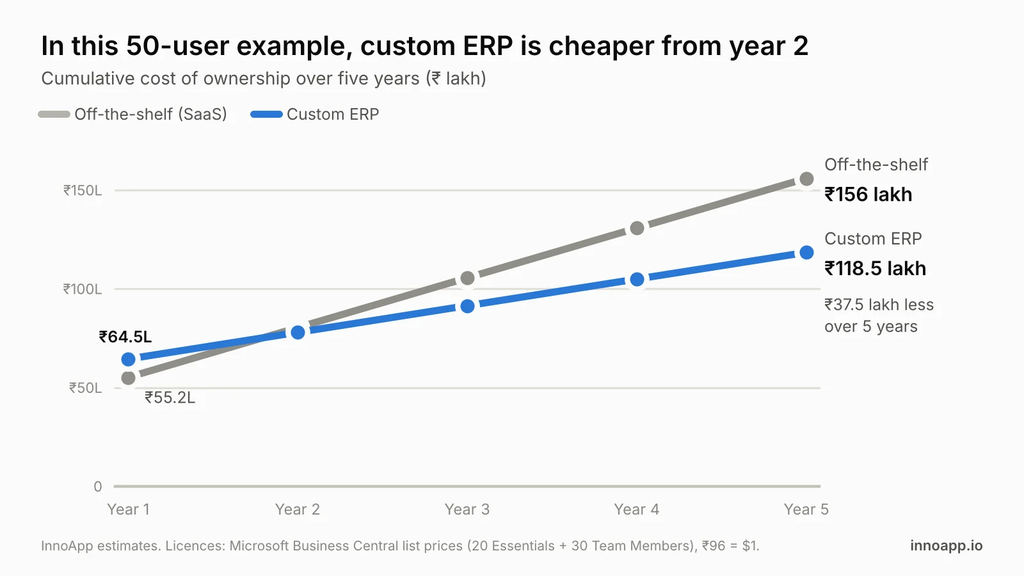
Licence prices are Microsoft Dynamics 365 Business Central list prices for its Essentials and Team Members plans, converted at ₹96 to the dollar; Microsoft notes local prices can differ. The other figures are InnoApp estimates.
The custom system costs ₹9.3 lakh more in year 1, becomes cheaper from year 2 and saves about ₹37.5 lakh over five years. Change the inputs and the answer can flip. With 15 users, a cheaper India-priced ERP or a narrow scope, off-the-shelf often stays cheaper for good.
When to Choose Custom vs Off-the-Shelf ERP
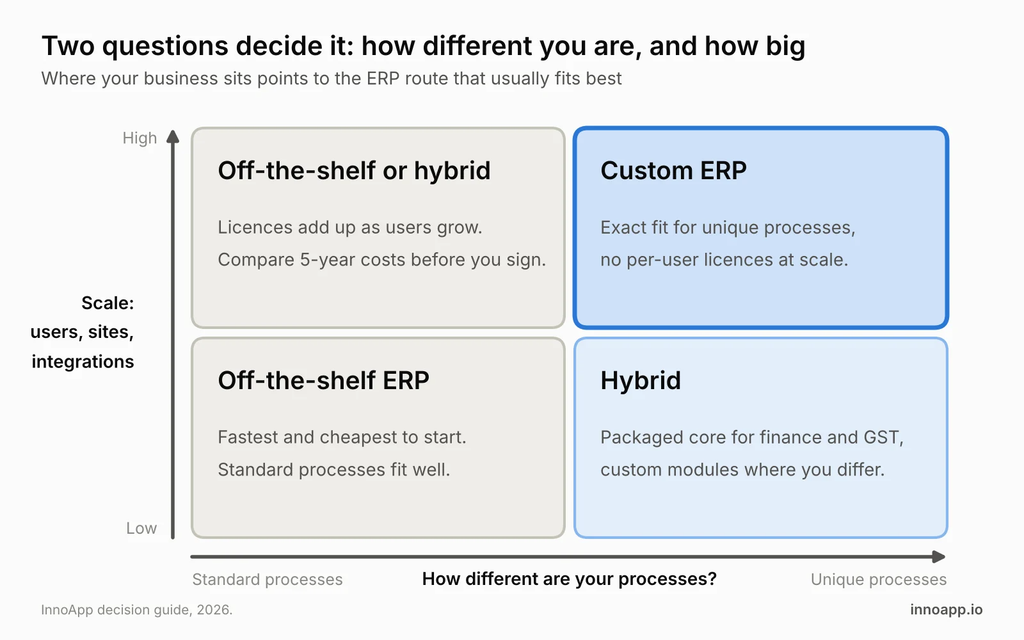
Two questions settle most cases: how different are your processes from the industry norm, and how large is your scale in users, sites and integrations?
Choose off-the-shelf ERP if
- Your processes follow industry norms, as in trading, distribution, services or standard discrete manufacturing
- You need to go live in months, not a year
- Your IT team is small and you want the vendor to handle upgrades and statutory changes
- Your user count is modest, so licences stay affordable
Choose custom ERP if
- Your processes are your edge: make-to-order, job work, complex costing or multi-plant scheduling
- You have many users, so per-user licences dominate the five-year cost
- The ERP has to talk to machines, PLCs, IoT sensors or legacy systems
- You already tried a packaged ERP and the workarounds have become a second system of spreadsheets
- You want to own the code as well as the data
The Hybrid Route: Off-the-Shelf Core, Custom Edges
For most mid-size Indian manufacturers, the best answer is neither extreme. Run finance, GST and payroll on a proven off-the-shelf core, and build custom modules only where you are different. APIs connect the two so data flows both ways.
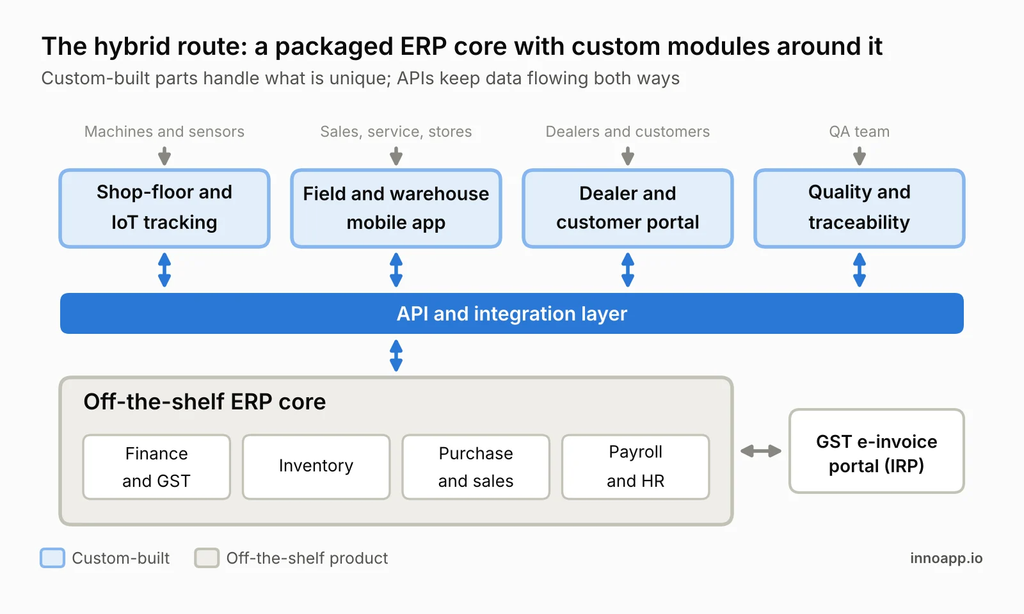
Typical custom modules around an ERP core:
- Shop-floor and production tracking fed by machines and IoT sensors
- A mobile app for field sales, service engineers or warehouse staff
- A dealer or customer portal for orders, dispatch status and invoices
- Quality and traceability records specific to your industry
The core stays close to standard, so upgrades stay clean. The parts that make you competitive fit exactly. Cost lands between the two options: the core’s licences plus a smaller build.
Common ERP Challenges and How to Solve Them
ERP projects slip on both routes. Panorama Consulting’s 2026 ERP Report, a survey of 170 organisations, found more than a quarter went over budget and nearly a quarter over schedule. The median project took nine months.
- Surprise costs. Panorama’s top cause of overruns was discovering the need for extra technology late. Map every process and integration before you sign, and keep a 15–20% contingency. FullStack’s 2026 price guide notes integrations and data migration alone can add 20–30% to a build.
- Scope creep in custom builds. Deliver in phases with a fixed scope each. Go live with finance, inventory and sales first, then add production and portals.
- Over-customised packages. Configure before you customise. Put logic that is unique to you in separate modules linked by API, so the core can still upgrade.
- Messy data migration. Clean item masters, bills of materials, customer records and GSTINs before go-live. Run the old and new systems in parallel for one month-end close.
- People, not software. Panorama found organisational issues were the most common cause of delays. Involve shop-floor users early and name a trained champion in every department.
- GST compliance. E-invoicing is mandatory above ₹5 crore aggregate turnover, and businesses at ₹10 crore or more must report e-invoices within 30 days. Confirm the package’s India localisation, or budget the e-invoice integration and statutory updates into a custom build.
How InnoApp Helps
We build custom ERP and extend off-the-shelf systems, so we can recommend whichever route fits. Through our business application services, we help you pick the right route and then deliver it:
- Assess: map your processes, users and integrations, and model the 5-year cost of each option with your own numbers.
- Build custom ERP: modules designed around your workflows and delivered in phases.
- Extend an off-the-shelf ERP: custom modules, mobile apps and portals connected to your existing system through APIs.
- Connect the shop floor: link machines and sensors to the ERP for our manufacturing, automotive and semiconductor clients.
We can build the same kind of 5-year cost model shown above from your own figures.
FAQs
What is the difference between custom ERP and off-the-shelf ERP?
Custom ERP is built for one company and owned by it. Off-the-shelf ERP is a ready-made product licensed to many companies and configured to fit. The first adapts to your processes; with the second, your processes adapt to it.
Is custom ERP more expensive than off-the-shelf ERP?
Upfront, yes. Over five years it can be cheaper, because there are no per-user licences. In our 50-user example, custom cost ₹1.19 crore against ₹1.56 crore for off-the-shelf. With few users, off-the-shelf usually stays cheaper.
How long does an ERP implementation take?
A typical SME rollout of off-the-shelf ERP takes 3–6 months. A custom ERP delivers its first modules in 4–6 months and a full system in 9–12 months. Panorama’s 2026 survey put the median project at nine months.
Can off-the-shelf ERP be customised?
Yes, through configuration, extensions and add-on modules. Heavy custom code inside the product makes upgrades harder, so keep unique logic in separate modules connected by API.
Is custom ERP a good choice for small businesses?
Usually not as a first ERP. A small business with standard processes gets more value from an off-the-shelf product. Custom makes sense once your processes, scale or integrations outgrow what packages handle well.
Can we move from off-the-shelf to custom ERP later?
Yes. Your data can be exported and migrated in phases. Start by replacing the module that causes the most workarounds, and keep the rest running until each replacement is proven.