
What Is Industrial IoT (IIoT)?
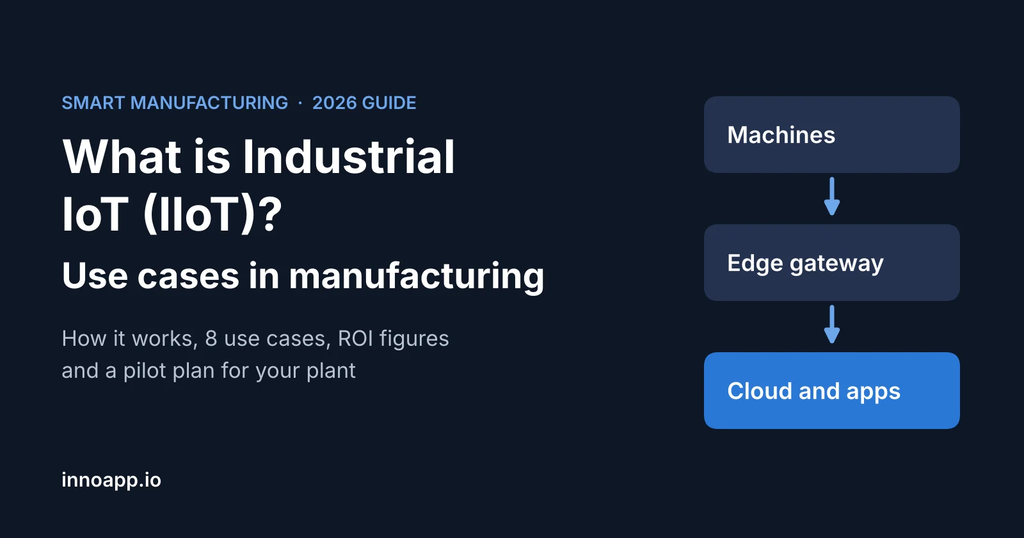
Industrial IoT (IIoT) is the use of connected sensors, machines and software in factories and other industrial sites to collect real-time data on equipment and processes. That data is analysed, at the edge or in the cloud, to cut downtime, improve quality, save energy and automate decisions across manufacturing operations.
IIoT is part of the wider Internet of Things. IoT Analytics estimated 21.1 billion connected IoT devices worldwide by the end of 2025 and expects 39 billion by 2030, with industrial and automotive uses among the main growth engines. IIoT is also the foundation of Industry 4.0: you cannot run analytics, AI or a digital twin without first getting data off the machines.
IoT vs IIoT
| Consumer IoT | Industrial IoT | |
|---|---|---|
| Typical devices | Smart speakers, wearables, home appliances | PLCs, CNC machines, sensors, meters, gateways |
| Cost of a failure | Inconvenience | Lost production, scrap, safety risk |
| Reliability needs | Best effort | Continuous running, often for years |
| Protocols | Wi-Fi, Bluetooth | OPC UA, Modbus, MQTT, Profinet, plus wired Ethernet |
| Environment | Home or office | Heat, dust, vibration and electrical noise |
| Security focus | Personal data | Keeping production running and safe |
How Industrial IoT Works
Every IIoT system, from one machine to a whole plant, has the same five layers. Data flows up from the shop floor, and decisions flow back down.
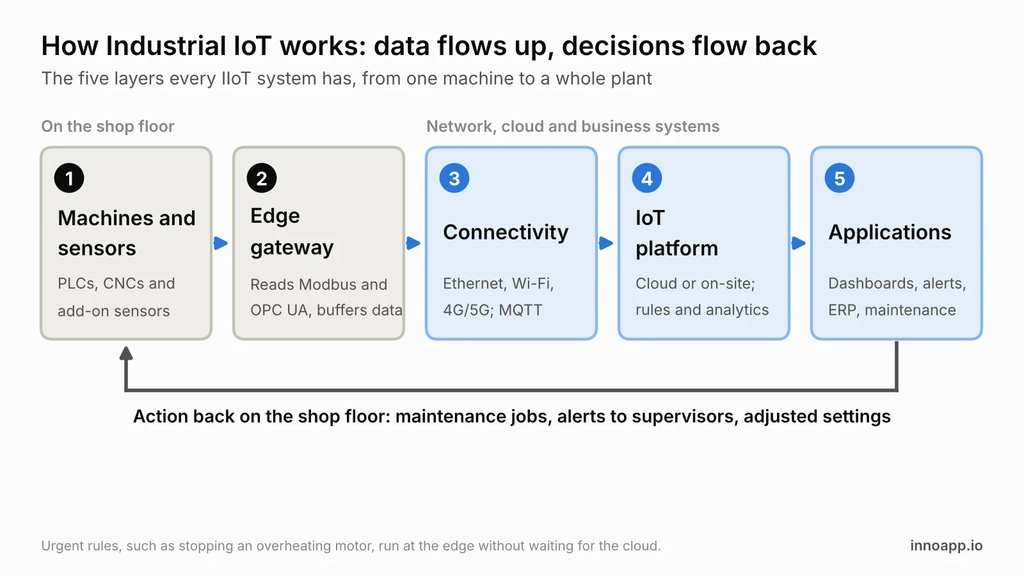
- Machines and sensors. PLCs and CNC controllers already hold useful data. Older machines get add-on sensors for vibration, temperature, current, pressure or energy.
- Edge gateway. A small industrial computer on the shop floor reads each machine in its own protocol, such as Modbus or OPC UA, cleans the data and buffers it if the network drops. Urgent rules, like stopping a motor that overheats, run here without waiting for the cloud.
- Connectivity. Wired Ethernet where you can, and Wi-Fi, 4G/5G or LoRaWAN where you can’t. MQTT is the common lightweight protocol for sending data upwards.
- IoT platform. On-premises or in the cloud, it stores time-series data, runs analytics and alert rules, and manages devices securely.
- Applications. Dashboards, mobile alerts and links to your ERP, maintenance and quality systems turn data into action, such as raising a maintenance job when vibration crosses a limit.
IIoT Use Cases in Manufacturing
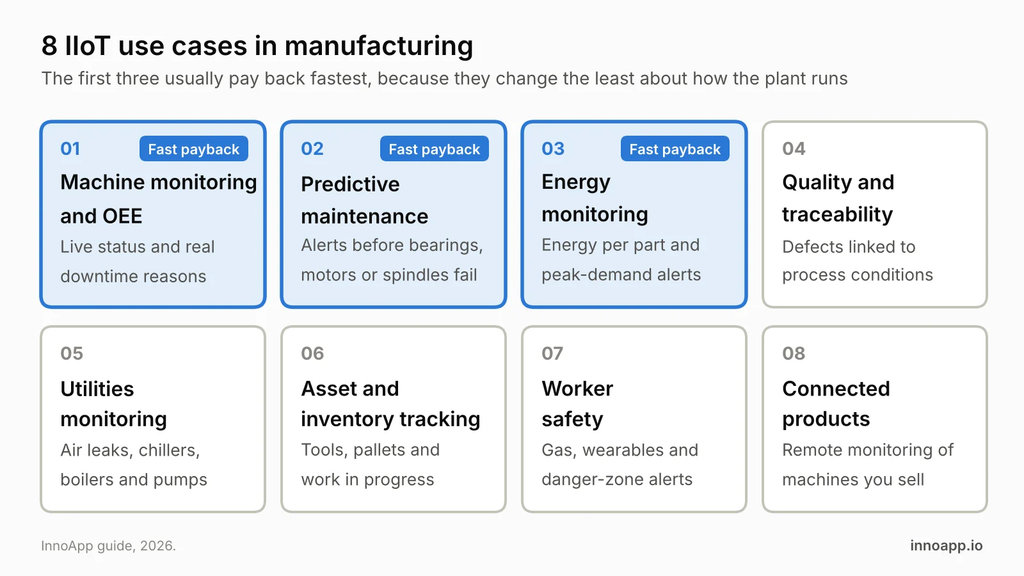
These eight use cases cover most of what manufacturers do with IIoT. The first three usually pay back fastest, because they need the least change to how the plant runs.
| Use case | What you connect | What you get |
|---|---|---|
| Machine monitoring and OEE | Machine controllers, cycle and spindle signals | Live status of every machine, overall equipment effectiveness (OEE) and the real reasons for downtime |
| Predictive maintenance | Vibration, temperature and motor-current sensors | Alerts days or weeks before a bearing, motor or spindle fails |
| Energy monitoring | Smart meters per machine, line or utility | Energy per part, peak-demand alerts and machines left idling |
| Quality and traceability | Process parameters, in-line gauges, vision cameras | Defects linked to the process conditions that caused them, and a full history for every batch |
| Utilities monitoring | Compressors, chillers, boilers, pumps | Compressed-air leaks, inefficient chillers and early warnings on critical utilities |
| Asset and inventory tracking | RFID or BLE tags on tools, bins and work in progress | Where every tool, pallet and batch is, without manual searching |
| Worker safety | Gas sensors, wearables, zone sensors | Alerts for unsafe conditions and people entering danger zones |
| Connected products (for OEMs) | Machines you sell to customers | Remote monitoring, service contracts and fewer site visits |
Once data flows from several of these, it can feed a digital twin: a live model of a line used to test changes before making them on the real floor.
Benefits and ROI of IIoT
The strongest published numbers are for predictive maintenance. The US Department of Energy’s Operations and Maintenance Best Practices Guide lists these industrial averages from starting a working predictive maintenance programme:
| Measure | Industrial average |
|---|---|
| Return on investment | 10 times |
| Reduction in maintenance costs | 25–30% |
| Breakdowns eliminated | 70–75% |
| Reduction in downtime | 35–45% |
| Increase in production | 20–25% |
The same guide finds predictive maintenance saves 8–12% over preventive maintenance alone, and over 30–40% for sites moving from fixing things only when they break.
Worked example: a 20-machine plant
Here is how we would model a monitoring and predictive maintenance pilot for a Chennai auto-components plant with 20 CNC machines. The assumptions are deliberately conservative:
| Item | Assumption |
|---|---|
| Unplanned downtime today | 8 hours per machine per month, 160 hours in total |
| Downtime avoided | 30%, below the DoE’s 35–45% range: 48 hours a month |
| Value of an hour of production | ₹4,000 of lost contribution per machine-hour |
| Monthly saving | ₹1.92 lakh |
| Sensors and edge gateways | ₹8 lakh (about ₹40,000 per machine) |
| Dashboards, alerts and integration | ₹12 lakh |
| Cloud and support | ₹3 lakh a year |
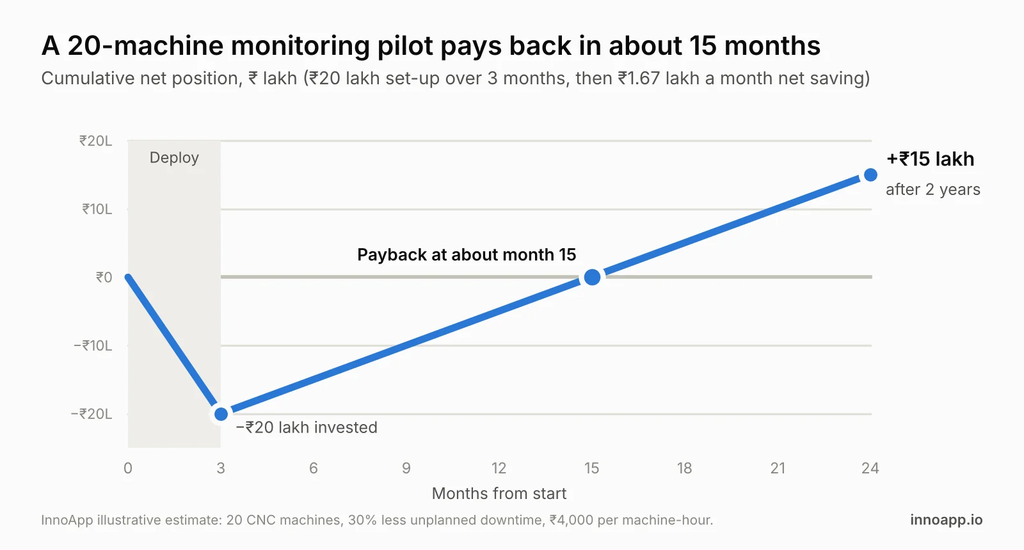
With three months to deploy, the pilot pays back in about 15 months and is roughly ₹15 lakh ahead after two years. Energy savings and quality gains come on top. Your own numbers will differ, so measure downtime for a month before you start.
[InnoApp editor: replace or support this with a real client result, such as an OEE or downtime improvement, if one can be shared.]
How to Start with IIoT: A Pilot Plan
Start small, prove value on one problem, then scale. A typical pilot runs about three months.
- Pick one problem and measure it. Choose a line where downtime, scrap or energy hurts most, and record a baseline for at least a month.
- Audit the machines. List each machine’s controller, age and available data ports. Note which can share data directly and which need add-on sensors.
- Connect a small set. Fit sensors and an edge gateway on five to ten machines. Wire them where possible, and keep the shop-floor network separate from office IT.
- Send insights to the right people. Build a simple dashboard and mobile alerts for supervisors and maintenance staff, not just a screen in the manager’s office.
- Run it and compare. Operate for 8–12 weeks and compare downtime, OEE or energy against the baseline.
- Scale and integrate. Roll out plant-wide, and link the data to ERP, maintenance and quality systems so alerts become work orders automatically.
Indian manufacturers can also see Industry 4.0 in action before investing. Under its Samarth Udyog Bharat 4.0 initiative, the Ministry of Heavy Industries has set up four SAMARTH centres: CMTI in Bengaluru, C4i4 Lab in Pune, iFactory in Ahmedabad and the IITD-AIA Foundation for Smart Manufacturing at IIT Delhi. They offer demonstrations, training and digital maturity assessments for MSMEs.
Common IIoT Challenges and How to Solve Them
Most IIoT projects that stall do so for practical reasons, not technical ones.
- Old machines with no data port. Retrofit them. Clamp-on current sensors, vibration sensors and stack-light readers capture run status and health without touching the controller.
- A mix of protocols. One plant can have Modbus, OPC UA, Profinet and vendor-specific formats. Translate them at the edge gateway into one standard model, usually sent over MQTT.
- Security risks on the shop floor. Connecting machines opens new paths for attackers. Separate the plant network from office IT, give each device its own credentials, encrypt traffic and follow the ISA/IEC 62443 series of industrial cybersecurity standards.
- Patchy wireless. Metal, motors and heat interfere with Wi-Fi. Use wired Ethernet for critical machines and site surveys before placing wireless sensors.
- Data with no action. Dashboards nobody watches change nothing. Route each alert to a named person and turn recurring alerts into maintenance work orders.
- Stuck in pilot. Tie the pilot to one business number from day one, such as downtime hours or energy per part, so the case for scaling is clear.
How InnoApp Helps
Our IoT solutions team builds connected device platforms and embedded systems that link hardware, edge and cloud for manufacturing, automotive and semiconductor clients.
- Assess: audit your machines and protocols, and pick the pilot with the clearest payback.
- Connect: retrofit sensors, set up edge gateways and bring legacy machines online alongside new ones.
- Analyse: build dashboards, alerts and predictive models on a secure platform, backed by our cloud engineering team.
- Integrate: feed machine data into ERP, maintenance and quality systems so it turns into action. If you are also choosing an ERP, see our guide to custom vs off-the-shelf ERP.
FAQs
What is the difference between IoT and IIoT?
IoT covers all connected devices, including consumer ones like smart speakers. IIoT is the industrial branch: machines, sensors and controllers in factories and plants, built for harsh conditions, continuous running and much higher stakes when something fails.
What are examples of IIoT in manufacturing?
The most common are machine monitoring and OEE tracking, predictive maintenance, energy monitoring, quality traceability, tool and inventory tracking, utilities monitoring and worker safety alerts.
How much does IIoT cost for a factory?
It depends on machine count and scope. In our 20-machine example, sensors and gateways cost about ₹8 lakh, software and integration ₹12 lakh and running costs ₹3 lakh a year. A focused pilot on five to ten machines costs much less.
Can old machines be connected to IIoT?
Yes. Machines without a data port can be retrofitted with clamp-on current sensors, vibration and temperature sensors or stack-light readers, so you can monitor them without changing their controls.
Is IIoT the same as Industry 4.0?
No. Industry 4.0 is the broader move to smart, connected manufacturing, including automation, AI, robotics and digital twins. IIoT is its foundation, because it supplies the machine data that everything else depends on.
Is IIoT secure?
It can be, if security is designed in from the start. Separate plant and office networks, encrypt traffic, manage device credentials and follow the ISA/IEC 62443 standards for industrial systems.