
What Are AWS, Azure and Google Cloud?
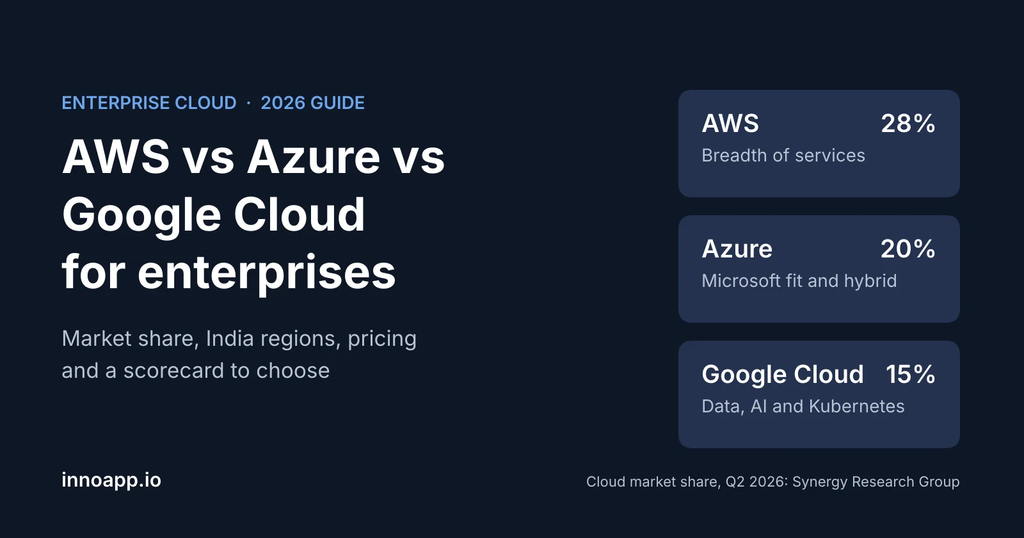
AWS (Amazon Web Services), Microsoft Azure and Google Cloud are the three largest public cloud platforms. Each rents computing power, storage, databases, networking and AI services on demand from data centres worldwide, billed by use. For enterprises, the differences lie in service depth, pricing models, hybrid options, AI tools and how well each fits existing software.
All three offer the same building blocks under different names: virtual machines, managed Kubernetes, object storage, managed databases and data warehouses. The choice is rarely about whether a service exists. It is about which ecosystem your people, licences and data already lean towards.
Cloud Market Share in 2026
The big three run almost two-thirds of the world’s cloud infrastructure. In Q2 2026, AWS held 28% of the market, Microsoft 20% and Google 15%, according to Synergy Research Group. Google’s share was a record high, while AWS slipped from about 30% a year earlier (Cloud Tech Daily).
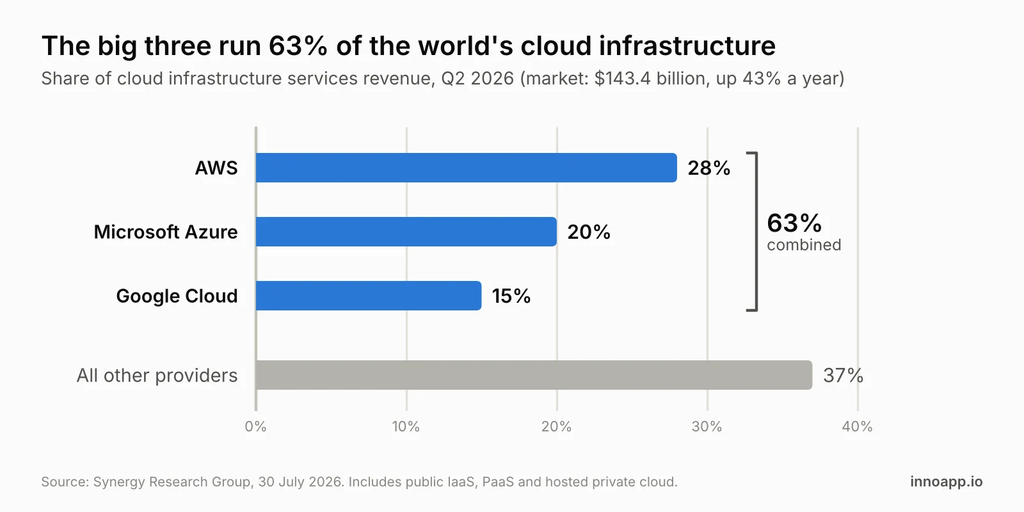
The market itself is growing fast. Spending on cloud infrastructure services reached $143.4 billion in the quarter, up 43% on a year earlier, its fastest growth in eight years. Synergy credits AI: generative AI cloud services alone grew 165%.
For buyers, share matters less than it seems. A larger provider means more partners, more trained engineers and more third-party tools. It does not mean a better fit for your workloads.
AWS vs Azure vs Google Cloud: Side-by-Side Comparison
All three can run almost any enterprise workload. They differ in where they are strongest and how they fit what you already own.
| Factor | AWS | Microsoft Azure | Google Cloud |
|---|---|---|---|
| Market share, Q2 2026 | 28% | 20% | 15% |
| Strongest at | Breadth of services, mature operations, largest partner and talent pool | Microsoft software, identity and hybrid setups | Data analytics, AI and Kubernetes |
| Best fit | Digital-native and mixed estates | Enterprises standardised on Microsoft | Data-led and engineering-led companies |
| Regions in India | 2: Mumbai, Hyderabad | 4: Pune, Hyderabad, Chennai, Mumbai | 2: Mumbai, Delhi |
| Managed Kubernetes | EKS | AKS | GKE (Google created Kubernetes) |
| Data warehouse | Redshift | Microsoft Fabric | BigQuery |
| Generative AI platform | Amazon Bedrock | Microsoft Foundry (formerly Azure AI Foundry) | Gemini Enterprise Agent Platform (formerly Vertex AI) |
| Hybrid and on-premises | AWS Outposts | Azure Arc, Azure Local | Google Distributed Cloud |
| Commitment discounts | Up to 72% | Up to 72%, more with existing Windows and SQL Server licences | Up to 70%, plus automatic sustained-use discounts |
The AI platform names changed recently. Microsoft renamed Azure AI Foundry to Microsoft Foundry from 1 January 2026, and Google expanded Vertex AI into the Gemini Enterprise Agent Platform in April 2026.
Cloud Regions and Compliance in India
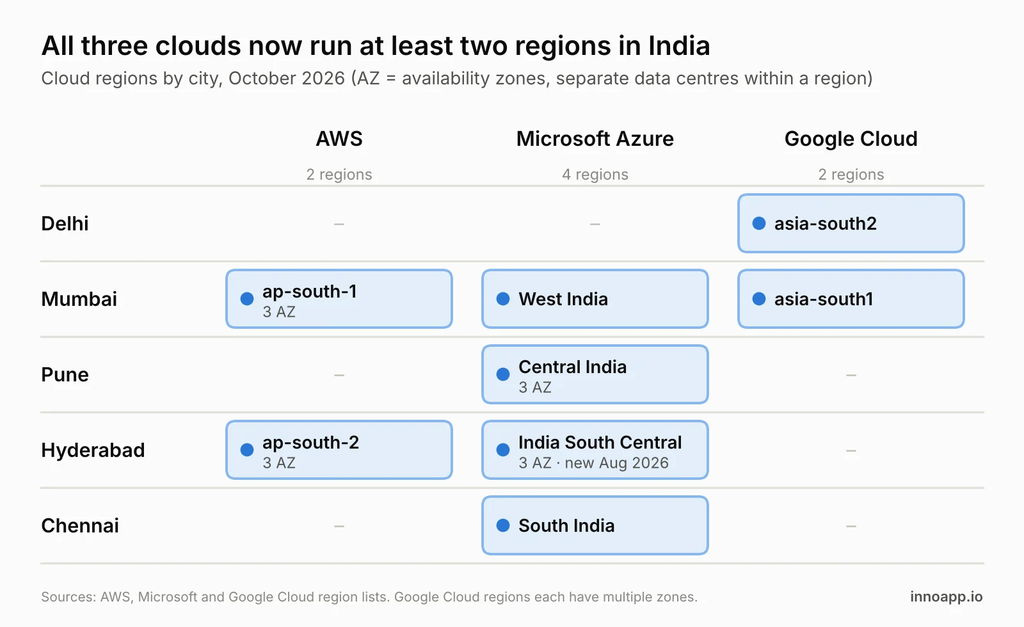
Every one of the three now runs at least two regions in India. That means you can keep data in the country and still have a disaster-recovery site in a second Indian city.
| Provider | India regions | Availability zones |
|---|---|---|
| AWS | Mumbai (ap-south-1); Hyderabad (ap-south-2, opt-in) | 3 in each region |
| Microsoft Azure | Central India (Pune); India South Central (Hyderabad, live since 6 August 2026); South India (Chennai); West India (Mumbai) | 3 each in Pune and Hyderabad; none in Chennai or Mumbai |
| Google Cloud | Mumbai (asia-south1); Delhi (asia-south2) | Multiple zones per region |
Sources: AWS, Microsoft and Google Cloud region lists; Microsoft’s Hyderabad launch.
Three compliance points matter most for Indian enterprises:
- Government work: all three are empanelled by MeitY for government workloads. AWS’s Mumbai and Hyderabad regions, Google’s Mumbai and Delhi regions and Microsoft’s cloud are covered. Check the current empanelment list for the exact services you plan to use.
- Payments data: the RBI’s 2018 direction requires payment system providers to store payment data only in India. Pin those workloads, backups included, to Indian regions.
- Personal data: the DPDP Rules, 2025 give organisations until May 2027 to put consent, security and breach-reporting controls in place. Your cloud’s encryption, logging and access tools help, but the obligations stay with you.
Pricing and Discounts: How Each Provider Charges
List prices for comparable virtual machines and storage are close across the three. What changes your bill is how well you use each provider’s discounts, licences and data-transfer rules.
| Lever | AWS | Azure | Google Cloud |
|---|---|---|---|
| 1- or 3-year commitment | Savings Plans and Reserved Instances, up to 72% off | Reservations up to 72% off; savings plan for compute up to 65% | Committed use discounts, up to 55–70% depending on resource |
| No-commitment discount | None automatic | None automatic | Sustained-use discounts of up to 30%, applied automatically |
| Spare capacity (can be interrupted) | Spot, up to 90% off | Spot VMs, up to 90% off | Spot VMs, 60–91% off |
| Existing licences | Bring your own, where licence terms allow | Azure Hybrid Benefit for Windows Server and SQL Server; with reservations, savings can reach 80% | Bring your own, where licence terms allow |
Discount figures as summarised by ProsperOps (updated December 2025). Check current terms with each provider before committing.
Two more costs catch enterprises out:
- Data transfer out. Moving data out to the internet or between regions is billed on all three. In 2024, all three stopped charging these fees for customers leaving their platform, which lowers the exit cost but not the day-to-day bill.
- Support plans. Enterprise support is a separate, usage-linked charge on every provider. Price it into your comparison from the start.
Which Cloud Fits Your Enterprise?
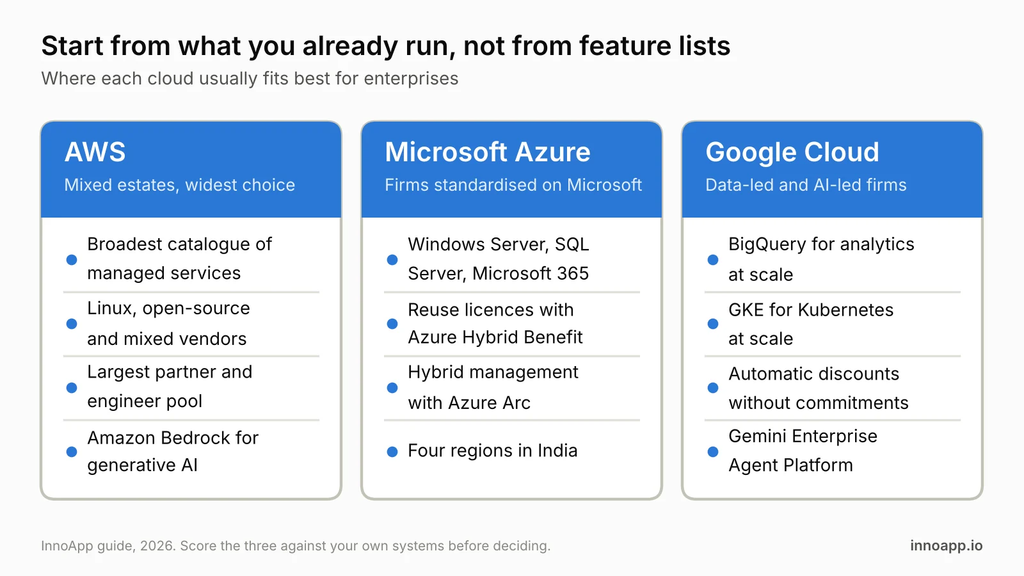
Start from what you already run and where you want to go, not from feature lists.
Choose AWS if
- You want the broadest catalogue of managed services and the most third-party integrations
- You run a mix of Linux, open-source and commercial software with no single dominant vendor
- You want the deepest pool of partners and engineers that comes with the largest market share
Choose Azure if
- Your company runs on Windows Server, SQL Server, Active Directory and Microsoft 365
- You want to reuse existing Microsoft licences through Azure Hybrid Benefit
- You need hybrid setups that manage on-premises servers and cloud from one place
Choose Google Cloud if
- Data analytics and AI are central to your plans, and BigQuery fits how your team works
- You run containers at scale on Kubernetes
- You want automatic discounts without having to manage commitments closely
Score it for your own business
Weight what matters to you, score each provider from 1 to 5, and multiply. Here is an example for a Chennai manufacturer that runs Windows Server, SQL Server and Microsoft 365, and plans to add plant-floor analytics:
| Criterion | Weight | AWS | Azure | Google Cloud |
|---|---|---|---|---|
| Fit with existing licences and skills | 25% | 3 | 5 | 2 |
| Data and AI roadmap | 20% | 4 | 4 | 5 |
| India regions and disaster recovery | 15% | 4 | 5 | 4 |
| Breadth of services and partners | 15% | 5 | 4 | 4 |
| Team skills and hiring | 15% | 4 | 4 | 3 |
| Cost after discounts and licences | 10% | 4 | 5 | 4 |
| Weighted score (out of 5) | 3.90 | 4.50 | 3.55 |
Azure wins here because of the Microsoft estate. Change the company and the answer changes: a data-first start-up with no Microsoft licences might score Google Cloud highest, and a firm with mixed, open-source systems might favour AWS. The weights and scores above are illustrative, not a recommendation for your business.
Multi-Cloud and Hybrid: When One Provider Is Not Enough
Most large organisations already run more than one environment. In Flexera’s 2026 State of the Cloud Report, a survey of 753 cloud decision-makers, 73% of organisations ran hybrid estates.
Multi-cloud makes sense when there is a clear reason, such as:
- Microsoft 365 and identity on Azure, with analytics on Google Cloud
- An acquired business that already runs on a different provider
- A specific AI model or service available on only one platform
- Regulators or customers who ask for a second provider for resilience
It costs more to run well: two sets of skills, security policies, monitoring and bills. Avoid spreading workloads across clouds just to avoid lock-in. Instead, pick a primary provider, use containers and infrastructure-as-code to keep workloads portable, and add a second cloud only where it earns its place.
Hybrid, where some systems stay on-premises, is common in manufacturing. Plant systems often must stay close to machines for speed and uptime, while ERP, analytics and customer apps move to the cloud. Azure Arc, AWS Outposts and Google Distributed Cloud each extend their cloud’s management tools into your own data centre.
Common Cloud Challenges and How to Solve Them
The provider you pick matters less than how you run it. These problems appear on every cloud.
- Wasted spend. Organisations estimate 29% of their cloud spend is wasted, up for the first time in five years as AI workloads grow, according to Flexera’s 2026 report. Tag every resource to an owner, switch off idle environments at night, right-size machines monthly and commit only to the steady base load.
- Lift-and-shift that costs more. Moving servers as they are can cost more than running them on-premises. Move first, then modernise: managed databases, autoscaling and containers are where the savings come from.
- Unexpected data-transfer bills. Keep chatty systems in the same region, cache content close to users and design data flows before you migrate, not after the first invoice.
- Skills gaps. Train your team on one platform deeply before adding another, and use landing-zone templates so every new project starts secure.
- Security misconfiguration. Many cloud incidents start with a wrong setting rather than a sophisticated attack. Enforce policies as code, turn on each provider’s security baseline and review access every quarter.
- Lock-in. Exit fees for leaving have gone, but proprietary services still tie you in. Use them where they add real value, and keep core data in open formats.
How InnoApp Helps
Our cloud engineering team helps enterprises migrate existing applications to the cloud or build cloud-native ones from the ground up, with DevOps and CI/CD practices built in.
- Choose with evidence: we run the weighted scorecard above with your own systems, licences and roadmap, and model costs after discounts.
- Migrate and modernise: move applications in waves, starting with low-risk systems, and modernise as you go.
- Connect the edge: link plant-floor machines and devices to the cloud through our IoT solutions practice.
- Build on it: cloud-backed business applications for your teams and customers.
Thinking about ERP in the cloud too? Read our guide to custom vs off-the-shelf ERP.
FAQs
Which is better for enterprises: AWS, Azure or Google Cloud?
None is best for every enterprise. Azure usually fits Microsoft-centred companies, AWS fits mixed estates that want the widest choice of services, and Google Cloud fits data- and AI-led businesses. Score them against your own systems and plans.
Which cloud has the largest market share?
AWS, with 28% in Q2 2026, followed by Microsoft at 20% and Google at 15%, according to Synergy Research Group. Together they hold about 63% of the market.
Is Azure cheaper than AWS?
List prices are similar. Azure often works out cheaper for companies with existing Windows Server and SQL Server licences, thanks to Azure Hybrid Benefit. Otherwise, how well you use commitments and right-sizing matters more than the provider.
Which cloud providers have data centres in India?
All three. AWS has regions in Mumbai and Hyderabad, Azure in Pune, Hyderabad, Chennai and Mumbai, and Google Cloud in Mumbai and Delhi.
Can an enterprise use more than one cloud?
Yes, and most large ones do in some form. Use a second provider for a clear reason, such as a specific service or an acquisition, because each extra cloud adds skills, security and billing overhead.
How hard is it to switch cloud providers?
Easier than it was. All three waived data-transfer fees for customers leaving in 2024. The bigger cost is rework for proprietary services, which is why containers, infrastructure-as-code and open data formats help.