What Is Generative AI?
Generative AI is a type of artificial intelligence that creates new content, such as text, code, images or summaries, in response to a prompt. It runs on large language models trained on vast amounts of data. In enterprises, it is used to draft, answer, summarise, translate and automate knowledge work, usually grounded in company data.
Traditional AI predicts or classifies: will this machine fail, is this transaction fraud? Generative AI produces: a draft reply, a summary of 40 pages, a piece of code. Newer AI agents go one step further and take actions, such as updating a record or raising a ticket, with varying levels of human approval.
Adoption in 2026: wide use, narrow returns
McKinsey’s 2026 State of AI survey, published in August 2026 with 1,719 respondents, shows how far use has spread and how few companies are capturing value:
- Nearly nine in ten respondents say their organisations regularly use AI in at least one business function.
- 44% say AI is being scaled across the enterprise, up from 38% a year earlier.
- 37% can attribute any EBIT impact to AI, unchanged from 2025.
- Only about 6% are “high performers”, attributing 5% or more of EBIT to AI.
The gap between use and value is the real story. The rest of this guide is about closing it.
Generative AI Use Cases by Business Function
These are the enterprise use cases with the clearest track record. Most start as an assistant that drafts or suggests, with a person approving the result.
| Function | Use case | What it does |
|---|---|---|
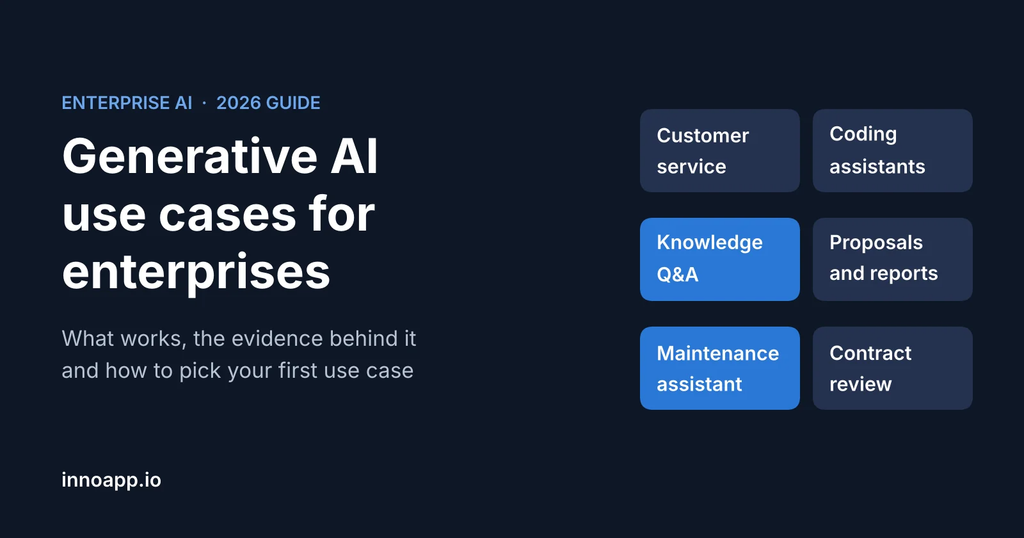
| Customer service | Agent assist and self-service | Suggests replies from the knowledge base, summarises cases and answers routine questions in many languages |
| Software engineering and IT | Coding assistants | Writes, explains, tests and reviews code; drafts documentation and migration scripts |
| Knowledge management | Enterprise search and Q&A | Answers staff questions from policies, manuals, contracts and past tickets, with links to the source |
| Sales | Proposals and account research | Drafts proposals, RFP responses and call summaries; prepares account briefs from CRM notes |
| Marketing | Content production | Drafts and localises campaigns, product copy and social posts in your brand voice |
| Finance | Document processing and reporting | Extracts data from invoices and contracts; drafts variance commentary and management reports |
| HR | Policy help and hiring support | Answers employee policy questions; drafts job descriptions and summarises interview notes |
| Legal and procurement | Contract review | Flags non-standard clauses, compares supplier terms and summarises obligations |
McKinsey’s 2026 survey finds AI-driven revenue gains are most often reported in marketing and sales, product development and software engineering, and cost reductions in supply chain, service operations and manufacturing.
What controlled studies actually show
Vendor surveys are easy to find. Rigorous studies are rarer, and they show both large gains and real limits:
| Study | Who | Result |
|---|---|---|
| Brynjolfsson, Li and Raymond, Quarterly Journal of Economics, 2025 | 5,179 customer support agents | 14% more issues resolved per hour; 34% for novice and low-skilled agents; little effect for the most experienced |
| Peng et al., 2023 | 95 developers, one set task | Developers with GitHub Copilot finished 55.8% faster |
| Dell’Acqua et al., Harvard and BCG, 2023 | 758 consultants | On tasks suited to AI: 12.2% more tasks, 25.1% faster and over 40% higher quality. On a task outside AI’s abilities: 19 percentage points less likely to be correct |
| METR, 2025 | 16 experienced open-source developers, 246 tasks | 19% slower on their own large codebases, though they believed AI had sped them up |
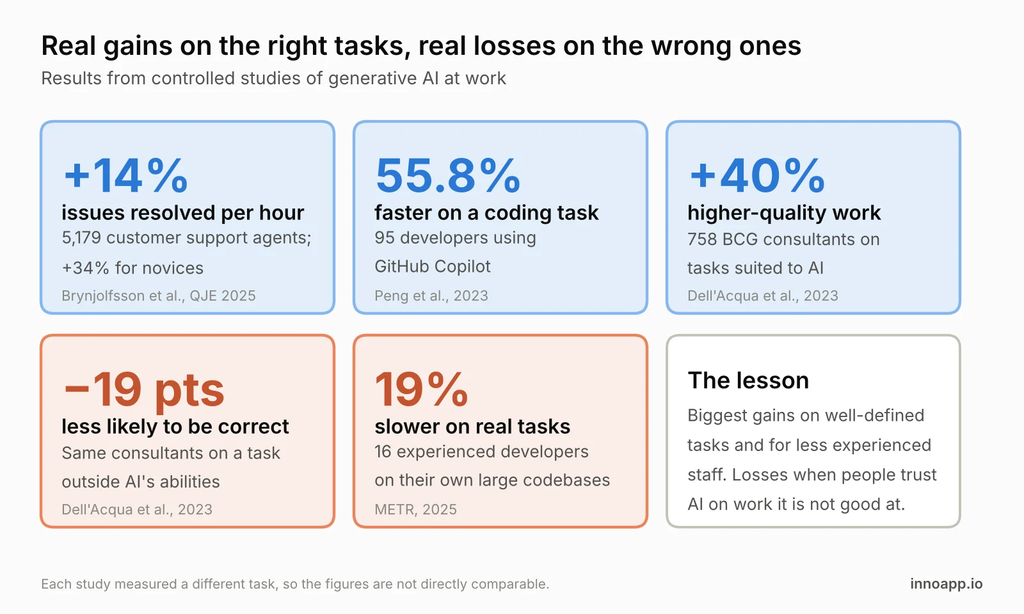
The lesson: generative AI helps most on well-defined tasks and less experienced staff, and it can hurt when people trust it on work it is not good at. Measure results on your own tasks before rolling out widely.
Generative AI Use Cases in Manufacturing
Manufacturers sit on decades of knowledge locked in manuals, drawings, SOPs, maintenance logs and the heads of senior staff. Generative AI is good at making that knowledge usable.
- Maintenance assistant. Technicians ask in plain language, “Why does press 4 trip on overload?”, and get an answer drawn from equipment manuals and past work orders, with links to the source.
- SOPs and work instructions. Draft and update standard operating procedures from engineers’ notes, and translate them into Tamil, Hindi or other shop-floor languages.
- Quality reports. Draft 8D and CAPA reports from defect data, inspection results and team notes, ready for engineers to check and sign off.
- Quotations and RFQs. Compare supplier quotes and terms, and draft customer quotations for configured products from past jobs.
- ERP and production data in plain language. Ask “Which orders are at risk this week?” instead of building a report, using the data from your ERP and machine connections.
- Training and onboarding. Turn manuals into short lessons and quizzes so new operators learn faster.
Worked example: a maintenance knowledge assistant
Take a plant with 25 maintenance technicians who each spend about an hour a day searching manuals, logs and old emails for fixes. If an assistant halves that time, the plant saves about 3,100 hours a year, worth roughly ₹18.75 lakh at a loaded cost of ₹600 an hour.
At an illustrative ₹15 lakh to build, plus about ₹4 lakh a year to run, it pays back in about a year, before counting faster repairs and less downtime. These are InnoApp estimates; measure your own search time for two weeks before you build.
[InnoApp editor: replace with a real client result if one can be shared.]
How Enterprise Generative AI Works
Most enterprise use cases follow the same pattern, called retrieval-augmented generation (RAG). Instead of relying on what a model learned in training, the system looks up the right company information first and asks the model to answer from it.
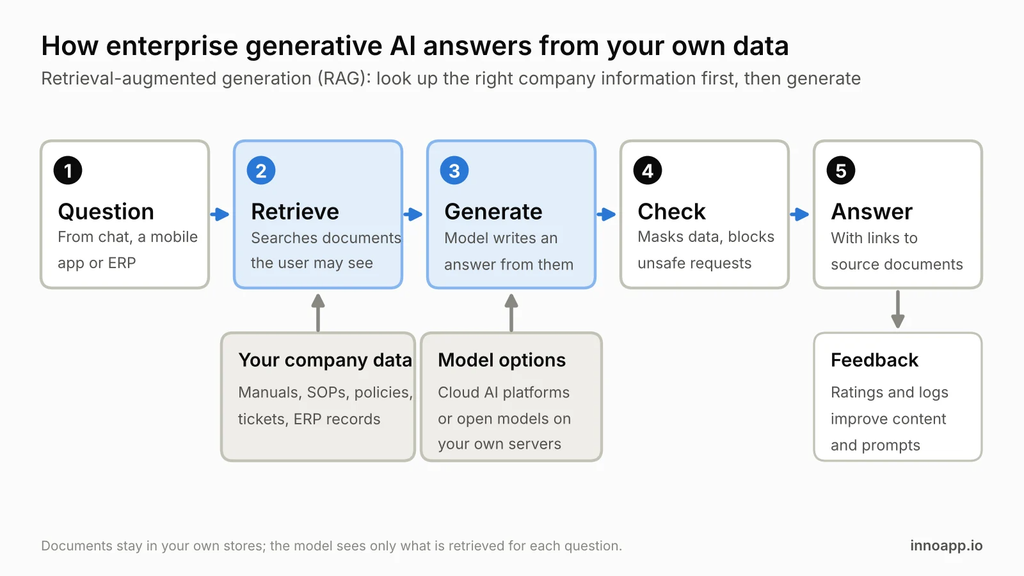
- Question. A user asks in a chat window, a mobile app or inside ERP.
- Retrieve. The system searches your documents and data, such as manuals, SOPs, tickets and ERP records, and returns only what that user is allowed to see.
- Generate. A large language model receives the question plus the retrieved passages and writes an answer. It can run through a cloud AI platform, such as Amazon Bedrock, Microsoft Foundry or Google’s Gemini Enterprise Agent Platform, or as an open model on your own servers.
- Check. Guardrails mask personal data, block unsafe requests and require the answer to cite its sources.
- Learn. User feedback and logs show where answers fall short, so the content and prompts can be improved.
Because your documents stay in your own stores and the model only sees what is retrieved for each question, RAG is usually cheaper and easier to control than training a custom model. For more on the platforms, see our comparison of AWS vs Azure vs Google Cloud.
How to Pick Your First Generative AI Use Cases
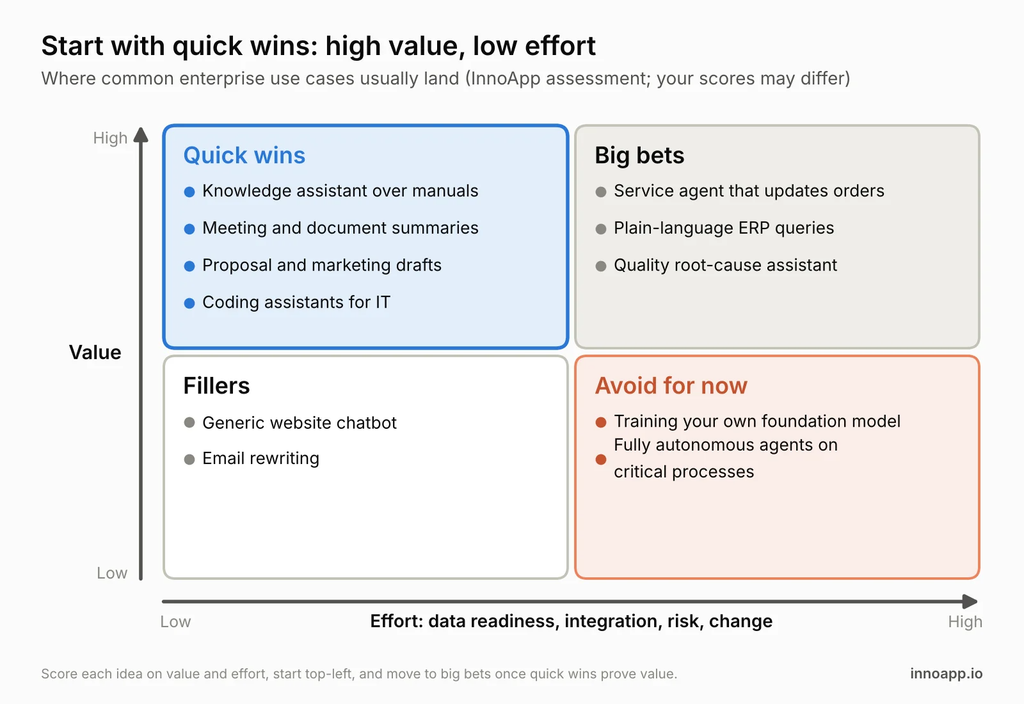
Score each idea on two things: the value it would create, and the effort to deliver it safely. Effort includes data readiness, integration, risk and change for the people involved.
| Quadrant | What belongs there | Examples |
|---|---|---|
| Quick wins: high value, low effort | Start here | Knowledge assistant over manuals and policies; meeting and document summaries; proposal and marketing drafts; coding assistants for IT |
| Big bets: high value, high effort | Plan once quick wins prove value | Customer service agent that updates orders; natural-language ERP queries; quality root-cause assistant using production data |
| Fillers: low value, low effort | Only if nearly free | Generic website chatbot; email rewriting |
| Avoid for now: low value, high effort | Skip | Training your own foundation model; fully autonomous agents on critical processes |
Then run each pilot like an experiment:
- Name one metric you will move, such as handling time, search time or first-time-right rate, and measure it before you start.
- Prepare the content. Clean, current documents matter more than the choice of model.
- Keep a person in the loop for anything customer-facing, financial or safety-related.
- Test against real questions, including tricky ones, and check answers against sources.
- Track usage and cost per answer from day one, then scale what works.
Be wary of anything sold as an autonomous agent. Gartner predicts that over 40% of agentic AI projects will be cancelled by the end of 2027 because of rising costs, unclear value or weak risk controls.
Risks and Challenges of Generative AI in the Enterprise
The risks are manageable, but only if you plan for them from the first pilot.
- Wrong answers stated confidently. Models can invent facts. Ground answers in your documents, require citations, and keep people approving anything that matters.
- Over-trust. The BCG study above showed people doing worse when they leaned on AI for tasks outside its strengths. Train staff on where the tool is and isn’t reliable.
- Data leakage. Use enterprise AI services with contracts that bar training on your data, keep access controls in retrieval, and mask personal data before it reaches the model.
- Prompt injection. Malicious text inside documents or emails can try to hijack an assistant. Limit what actions an AI can take, and require approval for anything that changes records or sends messages.
- Runaway costs. Usage-based pricing grows with adoption. Track cost per answer, cache common questions and use smaller models where they are good enough.
- Copyright and IP. Check the provider’s terms on ownership of outputs, and review generated marketing and code before publishing.
India’s rules
India has so far chosen not to propose a standalone AI law. The India AI Governance Guidelines, released by MeitY on 5 November 2025, set out seven principles, including people first, fairness, accountability and being understandable by design. They rely on existing laws such as the IT Act, the Digital Personal Data Protection Act, consumer protection and copyright law, and encourage voluntary frameworks, transparency and grievance-redress mechanisms.
In practice, the DPDP Act matters most. If an AI system processes personal data of customers or employees, the DPDP Rules’ consent, security and breach-reporting duties apply, with full compliance due by May 2027.
How InnoApp Helps
Generative AI is only as useful as the systems and data around it. Our teams help enterprises put it to work inside the applications they already run.
- Find the right first use case: score your ideas on value and effort, and define the metric each pilot must move.
- Prepare the data: organise manuals, SOPs, tickets and ERP data so they can be searched securely, with access controls intact.
- Build and integrate: add AI assistants to your business applications, ERP and mobile apps, on the AI platform that fits your cloud.
- Run it safely: set up guardrails, monitoring and cost tracking on a secure foundation from our cloud engineering team.
FAQs
What are the most common generative AI use cases in business?
Customer service assistance, coding assistants, enterprise search and Q&A over company documents, drafting sales and marketing content, and document processing in finance and legal.
How do enterprises use generative AI safely?
They ground answers in approved company data, keep access controls in place, mask personal data, require citations, keep people approving important outputs, and use enterprise AI services that don’t train on customer data.
What is the difference between generative AI and traditional AI?
Traditional AI predicts or classifies, such as forecasting demand or flagging fraud. Generative AI creates new content, such as text, code and summaries, in response to a prompt.
How is generative AI used in manufacturing?
As maintenance assistants that answer from manuals and work orders, for drafting SOPs and quality reports, translating work instructions, comparing supplier quotes and querying ERP and production data in plain language.
Do we need to train our own AI model?
Rarely. Most enterprise use cases work best with an existing model plus retrieval from your own documents. Training a model from scratch is expensive and seldom needed.
How much does an enterprise generative AI project cost?
It varies with scope, data readiness and usage. In our worked example, a maintenance assistant over existing documents costs about ₹15 lakh to build and ₹4 lakh a year to run. Agents that act across several systems cost far more. Start with one measurable use case to learn your real costs.