
What Is Native vs Cross-Platform App Development?
Native app development means building a separate app for each platform in its own language: Kotlin for Android and Swift for iOS. Cross-platform development means writing one codebase, usually with Flutter or React Native, that runs on both. Native gives the best performance and earliest access to new OS features; cross-platform ships both apps faster and for less.
You may also hear “hybrid app”. That usually means a web app wrapped in a mobile shell, an older approach that modern cross-platform frameworks have largely replaced.
How Native and Cross-Platform Apps Work
The difference is how many codebases you build and how the app reaches the phone’s hardware.
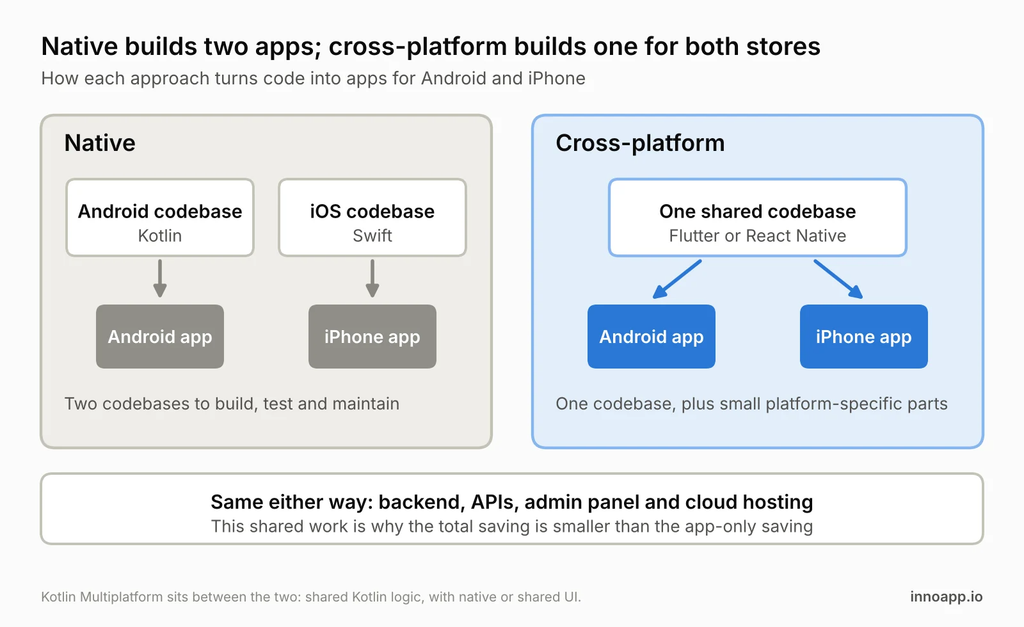
- Native: two teams, or one team working twice, write two apps. The Android app uses Kotlin and Google’s tools; the iOS app uses Swift and Apple’s tools. Each calls its operating system directly.
- Flutter: one Dart codebase draws its own interface with its own rendering engine, so the app looks the same on both platforms. Plugins reach the camera, Bluetooth and other hardware.
- React Native: one JavaScript or TypeScript codebase that drives the platform’s real native interface components.
- Kotlin Multiplatform: shares business logic, such as networking, data and rules, in Kotlin. The interface can stay native on each platform or be shared too.
Every approach still needs the same backend, APIs and admin panel. That matters for cost, as the worked example below shows.
Native vs Cross-Platform: Side-by-Side Comparison
Cross-platform wins on cost and speed. Native wins on performance ceiling and day-one access to new OS features.
| Factor | Native (Kotlin + Swift) | Cross-platform (Flutter or React Native) |
|---|---|---|
| Codebases | Two | One shared, plus small platform-specific parts |
| App build cost for both stores | About 1.8–2.0× a single native app | About 1.2–1.4× a single native app |
| Time to launch both apps | Longer, unless two teams work in parallel | Shorter; one team ships both |
| Performance | The best available, with full GPU and hardware access | Close to native for most business apps |
| New OS features | Available on release day | Once the framework or a plugin supports them, or through custom native code |
| Look and feel | Platform-standard by default | Flutter draws its own consistent UI; React Native uses native components |
| App size | Smaller | Usually larger, because the framework ships inside the app |
| Maintenance | Two codebases to update for every OS release | One codebase, plus framework upgrades |
| Team skills | Kotlin and Swift developers | Dart (Flutter) or JavaScript/TypeScript (React Native) developers |
Cost multipliers are InnoApp estimates for the app itself, excluding the backend.
The Same App Built Both Ways
Headline savings are quoted for the app alone. Your budget covers the whole project, and much of it is shared. Here is the single-city grocery ordering app from our mobile app cost guide, estimated both ways:
| Phase | Flutter, both stores (hours) | Two native apps (hours) |
|---|---|---|
| Discovery and scoping | 60 | 60 |
| UI/UX design | 140 | 170 |
| Mobile app build | 400 | 590 |
| Backend and APIs | 320 | 320 |
| Admin web panel | 120 | 120 |
| QA and device testing | 180 | 240 |
| Project management and launch | 100 | 120 |
| Total | 1,320 (₹26.4 lakh) | 1,620 (₹32.4 lakh) |
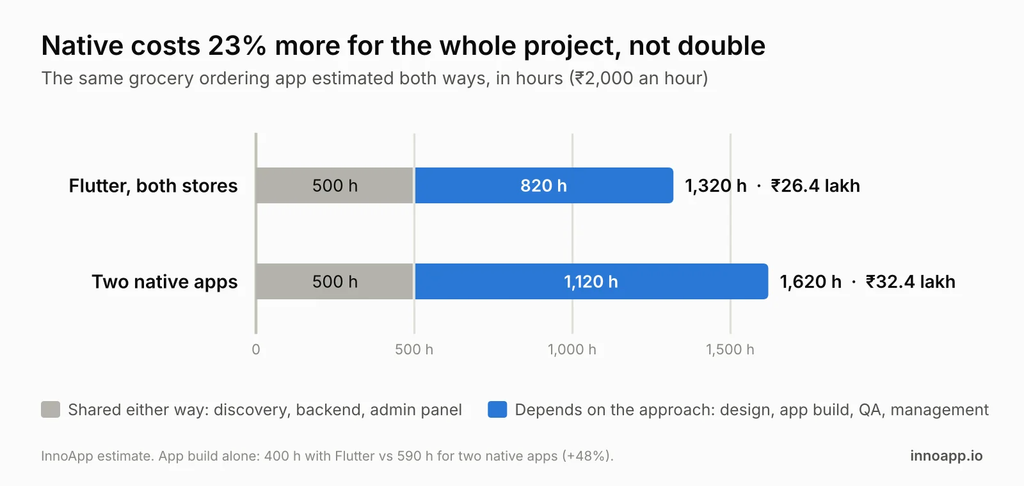
At ₹2,000 an hour, native costs ₹6 lakh, or 23%, more. The app build alone is about 48% more, but discovery, backend and admin cost the same either way. Native also means two codebases to maintain every year.
Cross-Platform Options in 2026: Flutter, React Native and Kotlin Multiplatform
All three are mature, and each closed a long-standing gap with native in the last two years.
| Option | Backed by | Language | Recent change that matters |
|---|---|---|---|
| Flutter | Dart | Its Impeller rendering engine became the default on iOS and Android in Flutter 3.27, which removed the first-run stutter older Flutter apps had (Flutter docs) | |
| React Native | Meta | JavaScript / TypeScript | The New Architecture became the default in 0.76, and 0.82 (October 2025) dropped the old bridge entirely (React Native blog) |
| Kotlin Multiplatform | JetBrains | Kotlin | Compose Multiplatform for iOS became stable in May 2025, so teams can now share UI as well as logic (JetBrains) |
Flutter and React Native are close in developer adoption. In the 2024 Stack Overflow Developer Survey, 9.4% of developers used Flutter and 8.4% used React Native, as summarised by Droids On Roids. The 2025 survey dropped that category, so 2024 is the latest like-for-like comparison.
In practice:
- Flutter suits apps that need a custom, brand-led design that looks identical on both platforms.
- React Native suits teams that already work in React for the web and want to share skills or code.
- Kotlin Multiplatform suits companies with an existing native Android app, or those that want native UI on each platform with shared logic underneath.
How to Choose Native or Cross-Platform
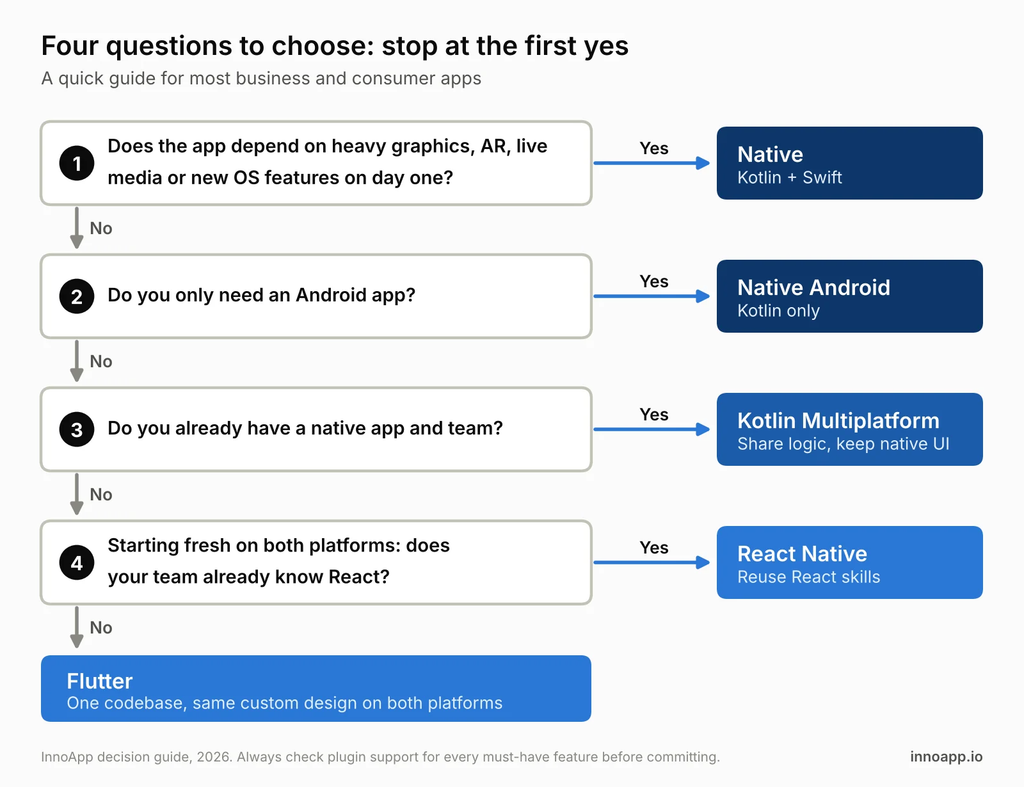
Four questions settle most projects. Answer them in order and stop at the first “yes”.
- Does the app depend on heavy graphics, AR, low-latency audio or video, or new OS features on day one? Go native.
- Do you only need Android? Build one native Kotlin app. Android ran on 93.9% of mobile devices in India in September 2026, against 6.1% for iOS (Statcounter), so many India-first consumer apps launch on Android alone.
- Do you already have a native app and team? Use Kotlin Multiplatform to share logic, without rewriting what works.
- Starting fresh on both platforms? Go cross-platform: React Native if your team knows React, Flutter otherwise.
Native is usually the better choice for
- Games, AR, camera, video editing and music apps
- Apps that lean hard on Bluetooth, NFC or long-running background work, where plugin support can lag
- Apps that must adopt each new OS design and API on release day
- Products where the app is the business and you can fund two specialist teams
Cross-platform is usually the better choice for
- E-commerce, booking, delivery, fintech front-ends and internal business apps
- MVPs that need both stores quickly to test the market
- Teams with one budget and one set of developers
- Apps whose design should look the same on every phone
Common Challenges and How to Solve Them
Neither approach is free of problems. These are the ones we see most often.
- A plugin doesn’t exist or is poorly maintained. Check plugin support for every must-have feature before you commit. Where a gap exists, budget for a small native module, which both Flutter and React Native support.
- Slow performance on budget Android phones. Profile on real entry-level devices from week one, not only on flagship phones. Keep images light and long lists lazy-loaded.
- New OS designs arrive before framework support. When Apple introduced Liquid Glass with iOS 26, native SwiftUI apps adopted it with little effort, while React Native relied on a community library and Flutter on community packages and approximations. If matching every new iOS look on day one matters, factor that in.
- Framework upgrades break things. React Native 0.82 removed the old architecture entirely, so apps that skipped upgrades faced a bigger migration. Upgrade on a regular schedule rather than in one painful jump.
- Larger app size. Cross-platform apps bundle their framework. Use app bundles, split builds by CPU type and compress assets to keep downloads small on limited data plans.
- Two native codebases drift apart. With native, features ship on one platform before the other and bugs differ between them. Share one API contract and test plan, and release both together.
How InnoApp Helps
Our mobile application development team builds both native and cross-platform apps, so we can recommend whichever fits your product rather than the stack we happen to prefer.
- Choose with evidence: we run your must-have features through the four questions above, check plugin support for each, and estimate both routes in hours.
- Build and launch: native Android and iOS apps or one cross-platform app, backed by our cloud engineering team for the APIs and infrastructure behind the app.
- Connect devices: companion apps for connected products, built with our IoT solutions team, where Bluetooth pairing and device provisioning decide the stack.
Not sure what the app will cost? Start with our guide to mobile app development cost in India.
FAQs
Is cross-platform as good as native?
For most business apps, users can’t tell the difference. Flutter’s Impeller engine and React Native’s New Architecture have closed most of the old performance gap. Native still leads for heavy graphics, AR and day-one use of new OS features.
Is cross-platform development cheaper than native?
Yes. One cross-platform app for both stores costs about 1.2–1.4 times a single native app, against 1.8–2 times for two native apps. Across a whole project, including backend and admin, the saving is smaller: about 23% in our worked example.
Which is better, Flutter or React Native?
Neither wins outright. Flutter suits custom, brand-led designs that should look identical everywhere. React Native suits teams that already use React and want native interface components.
Is a hybrid app the same as a cross-platform app?
Not quite. A hybrid app usually wraps a web app in a mobile shell, while Flutter and React Native apps compile to, or drive, real native code. People do use the terms loosely, so ask which technology a quote is based on.
Should I build only for Android in India?
For many consumer apps, yes at first. Android ran on about 94% of mobile devices in India in September 2026. If you sell to premium consumers or businesses, check your own analytics first, because your audience may not match the national average.
Can I move from cross-platform to native later?
Yes, though it means rebuilding the app layer. Your backend and APIs carry over unchanged. Kotlin Multiplatform also lets you move step by step, one shared module at a time.