What Is Mobile App Development Cost?
Mobile app development cost is the total amount you pay to plan, design, build, test and launch an app on Android, iOS or both. It is mostly labour: estimated hours multiplied by a team’s hourly rate. Store fees, cloud hosting, third-party services and yearly maintenance sit on top of that build cost.
In short: build cost = estimated hours × blended hourly rate. Most Indian agencies bill a blended team rate of about ₹1,500–3,500 an hour. Every range in this guide uses ₹2,000 an hour as the midpoint, so you can rescale it to any quote.
Mobile App Development Cost in India by Complexity
Complexity sets the hours, and hours set the price. Most business apps land in the medium band.
| Complexity | Typical features | Effort | Cost (India, 2026) | Timeline |
|---|---|---|---|---|
| Simple app / MVP | 5–10 screens, login, catalogue or content, basic admin, no payments | 200–500 hours | ₹4–10 lakh | 2–3 months |
| Medium complexity | 15–30 screens, UPI and card payments, push notifications, maps, admin panel, third-party APIs | 500–1,500 hours | ₹10–30 lakh | 3–6 months |
| Complex | Several user roles, real-time chat or tracking, video, analytics, ERP or IoT integrations | 1,500–3,000 hours | ₹30–60 lakh | 6–9 months |
| Enterprise | Several connected apps, strict security and compliance, offline sync, AI features, SLA-backed support | 3,000+ hours | ₹60 lakh–₹1.5 crore+ | 9–15 months |
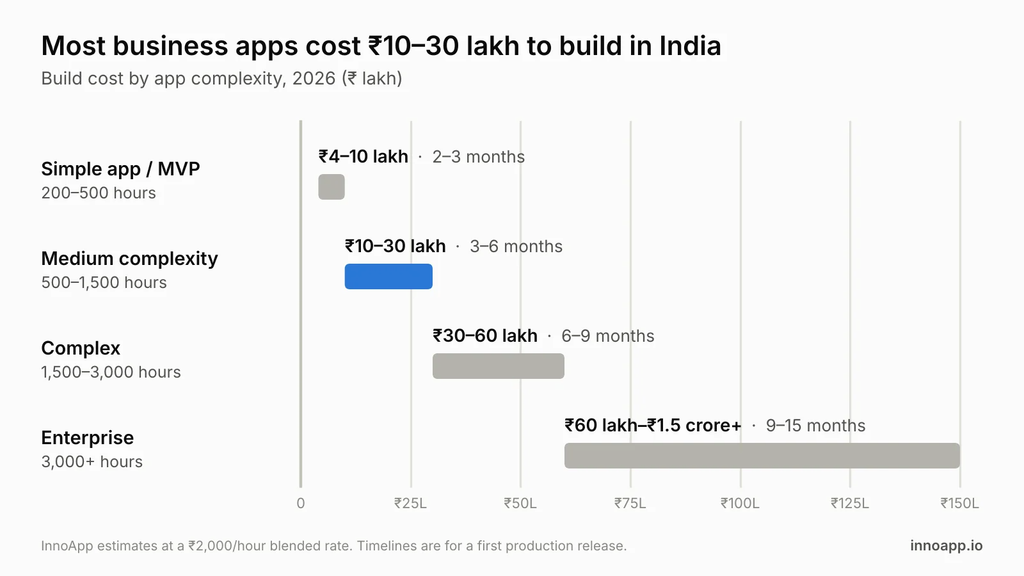
These bands line up with independent data. Clutch’s 2026 app pricing guide finds most reviewed app projects cost $10,000–49,999, roughly ₹10–48 lakh at today’s exchange rate of about ₹96 to the dollar.
App Development Cost by App Type
The industry does not change the hourly rate much, but it decides which costly features are non-negotiable. These are indicative ranges for a first production release in India.
| App type | Indicative cost | What pushes it up |
|---|---|---|
| Booking or service app (clinic, salon, gym) | ₹6–15 lakh | Calendar sync, reminders, payments |
| E-commerce / D2C store | ₹10–30 lakh | Catalogue size, UPI checkout, order tracking, returns |
| EdTech / e-learning | ₹12–35 lakh | Video streaming, live classes, quizzes, offline downloads |
| Healthcare / telemedicine | ₹20–50 lakh | Video consults, health records, consent and data security |
| IoT companion or field-force app | ₹15–45 lakh | Bluetooth pairing, device provisioning, offline sync, ERP links |
| On-demand delivery (food, grocery, rides) | ₹30–70 lakh | Three apps (customer, partner, admin), live GPS tracking |
| Fintech (payments, lending, wealth) | ₹35–90 lakh | KYC, bank and UPI integrations, audit trails, security testing |
An “app like Swiggy or Zomato” is really three apps and a dispatch system. Its first version usually costs several times a single-app e-commerce store.
What Drives the Cost of Building an App in India
Five things move the number: platform, features, India-specific requirements, the team you hire and how well the scope is defined.
Platform: Android, iOS or cross-platform
| Approach | Cost vs one native app | Best for |
|---|---|---|
| One native app (Android only) | 1.0× | Mass-market consumer apps, where Android dominates in India |
| Cross-platform for both stores (Flutter or React Native) | About 1.2–1.4× | Most startups and business apps |
| Two native apps (Kotlin and Swift) | About 1.8–2.0× | Heavy graphics, deep hardware access, top-end performance |
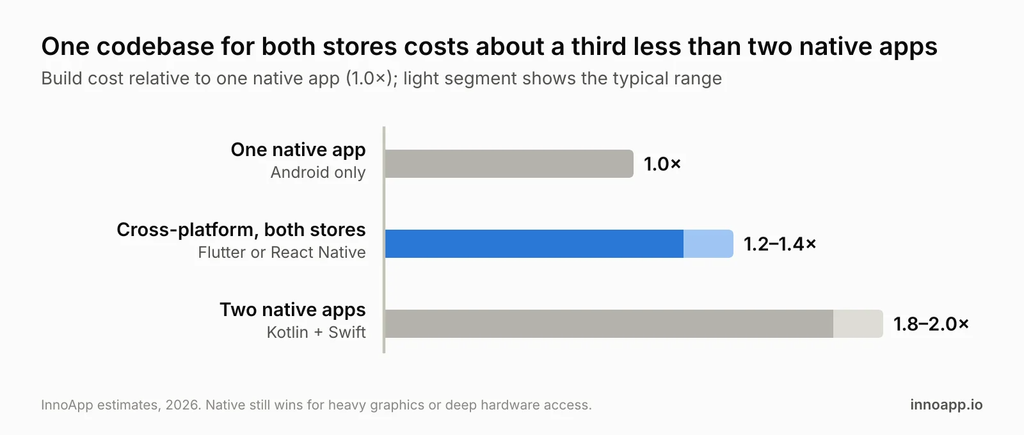
Two native apps mean two codebases to build and maintain, which is why they cost nearly double. For most Indian businesses, one Flutter codebase for both stores is the better trade-off.
Features and integrations
A handful of features account for most of the variation between quotes:
- Payments and wallets, especially with refunds and reconciliation
- Real-time features: chat, live tracking, live video
- Offline sync for field teams with patchy coverage
- AI features such as recommendations, chatbots or document scanning
- Integrations with ERP, CRM, logistics or IoT systems
Integrations are the most underestimated item. FullStack’s 2026 software price guide notes that significant integrations and data migration can add roughly 20–30% to an initial build, and scope changes another 10–25%.
India-specific requirements
Global cost guides miss these, but Indian apps almost always need them:
- UPI-first checkout through a gateway such as Razorpay or PhonePe, with payment status handling and reconciliation
- Regional languages such as Hindi, Tamil or Telugu, which add translation work and layout testing for longer scripts
- Budget Android phones and weak networks, which call for smaller app sizes, offline states and testing on low-end devices
- DPDP compliance: the Digital Personal Data Protection Rules, 2025, notified on 14 November 2025, give organisations an 18-month phased window. Apps launching now need clear consent notices, data deletion and breach-response flows built in.
Team and engagement model
A freelancer is cheaper per hour, but an agency rate includes a project manager, QA, architecture review and cover if someone leaves. Seniority also matters: a senior team that gets the architecture right the first time often costs less overall than a cheaper team that needs a rebuild.
Worked example: estimating a mid-complexity app
Here is how we would estimate a single-city grocery ordering app. It has a Flutter app for Android and iOS, UPI checkout through Razorpay, push notifications and a web admin panel for the store.
| Phase | Hours | Cost at ₹2,000/hour |
|---|---|---|
| Discovery and scoping | 60 | ₹1.2 lakh |
| UI/UX design | 140 | ₹2.8 lakh |
| Flutter app (Android + iOS) | 400 | ₹8.0 lakh |
| Backend and APIs | 320 | ₹6.4 lakh |
| Admin web panel | 120 | ₹2.4 lakh |
| QA and device testing | 180 | ₹3.6 lakh |
| Project management and launch | 100 | ₹2.0 lakh |
| Total | 1,320 | ₹26.4 lakh |
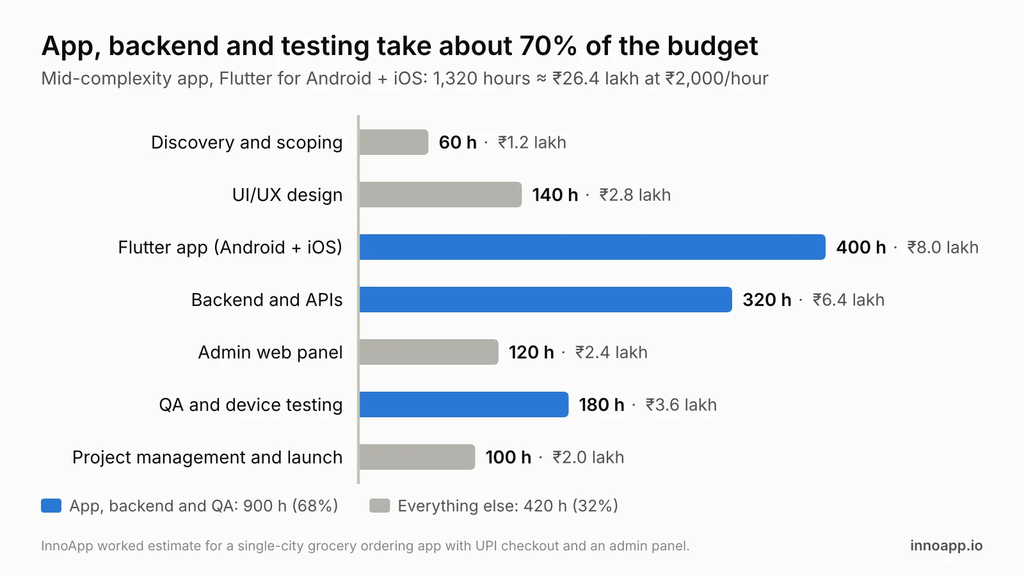
At blended rates of ₹1,500–2,500 an hour, the same scope costs ₹19.8–33 lakh. Building and testing the app itself, plus its backend, takes about 70% of the budget.
[InnoApp editor: add a real project number here, such as the hours and cost of a recent app, plus a one-line quote from the engineer who estimated it.]
India vs Other Countries: Hourly Rates in 2026
India remains one of the lowest-cost places to build an app. Clutch’s pricing data puts the average Indian mobile app company at under $25 an hour, and FullStack’s 2026 guide places Indian agencies at roughly $25–75.
| Provider / market | Typical agency rate (USD per hour) |
|---|---|
| India agency | $25–75 |
| Southeast Asia agency | $25–65 |
| Latin America agency | $40–100 |
| Boutique or small agency (published tier rates) | $75–250 |
| Mid-market custom development firm | $100–300 |
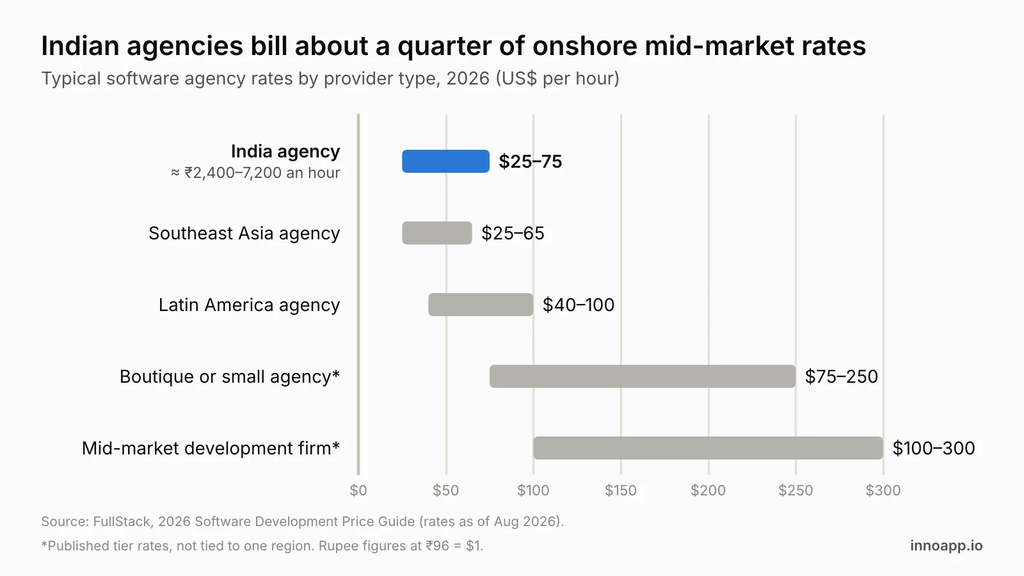
Source: FullStack, 2026 Software Development Price Guide (rates as of August 2026).
The same 1,320-hour app from the worked example would cost about $33,000–99,000 at Indian agency rates, and $132,000–396,000 at a mid-market onshore firm. Rate is not the whole story, though: time-zone overlap, communication and rework decide the final bill.
Hidden and Ongoing Costs to Budget For
The build quote is not the total cost of owning an app. Plan for these from day one.
| Cost | Typical amount | How often |
|---|---|---|
| Maintenance: OS updates, bug fixes, security patches | 10–20% of the build cost | Every year |
| Cloud hosting and backend services | ₹5,000–50,000+ a month for small to mid-size apps | Monthly |
| Third-party services: SMS OTP, maps, email, analytics | Usage-based | Monthly |
| Payment gateway fees | A percentage per transaction | Ongoing |
| Apple Developer Program | $99, charged in local currency | Every year |
| Google Play Console registration | $25 | One time |
| Security testing for fintech or health apps | Depends on scope | Before launch and after major releases |
The 10–20% maintenance figure comes from GoodFirms’ 2026 survey, as cited in the FullStack guide above. For the ₹26.4 lakh example, that is ₹2.6–5.3 lakh a year. Skipping it is how apps break after the next Android or iOS release.
How to Reduce App Development Cost Without Cutting Quality
The cheapest real saving comes from cutting scope, not cutting the rate. These steps work:
- Start with an MVP. Ship the one journey users pay for, then add features based on real usage.
- Pay for discovery first. A one- to two-week scoping phase costs a few percent of the budget and prevents the 10–25% scope drift that follows vague requirements.
- Use one cross-platform codebase. Flutter or React Native covers both stores for well under the price of two native apps.
- Buy, don’t build, the commodity parts. Use proven services for login, payments, chat and notifications.
- Design the backend for growth. Cloud-native architecture avoids an expensive rebuild when users grow from thousands to lakhs.
- Test on real budget devices early. Fixing performance on low-end Android phones before launch is far cheaper than after bad reviews.
Be wary of quotes far below the bands above. They usually mean junior-only teams, no QA or no admin panel, and the gap shows up later as rework.
How InnoApp Helps
InnoApp is a Chennai-based product engineering company. Our mobile application development team builds native and cross-platform apps for customer-facing products and internal enterprise tools.
Where we differ from an app-only shop is everything around the app:
- Backend and cloud: our cloud engineering team designs APIs and infrastructure that scale with your users.
- Connected devices: our IoT solutions practice handles Bluetooth pairing, device provisioning and edge-to-cloud data for manufacturing and automotive clients.
- Enterprise integration: through our business application services, we connect apps to ERP and CRM systems instead of leaving them as data islands.
Every engagement starts with a scoped estimate built the same way as the worked example above: phases, hours and a rate you can see.
FAQs
How much does it cost to make an app in India?
A simple app costs about ₹4–10 lakh, a mid-complexity app ₹10–30 lakh and a complex app ₹30–60 lakh. Enterprise platforms start around ₹60 lakh and can pass ₹1.5 crore.
Is it cheaper to build an app in India than in the US?
Yes. Indian agencies typically bill $25–75 an hour, against $100–300 for mid-market onshore development firms. The same scope often costs a third or less.
How long does it take to build an app in India?
Plan on 2–3 months for a simple app, 3–6 months for a mid-complexity app and 6–9 months or more for a complex one. A clear scope shortens every one of these.
How much does app maintenance cost per year?
Budget 10–20% of the original build cost every year. That covers OS updates, bug fixes, security patches and small improvements, but not hosting or third-party service fees.
Is Flutter cheaper than native app development?
Usually. One Flutter codebase for Android and iOS costs about 1.2–1.4 times a single native app, while two native apps cost about 1.8–2 times. Native still wins for heavy graphics or deep hardware access.
How much does an app like Swiggy or Zomato cost in India?
A first version typically costs ₹30–70 lakh. It needs three apps (customer, delivery partner, restaurant or admin), live tracking and order dispatch, which is why it costs far more than a single store app.