What is a product engineering partner?
A product engineering partner is an external team that shares responsibility for building and growing your product: architecture, design, development, testing, release and support. Unlike a vendor that delivers to a fixed spec, a partner questions requirements, suggests better approaches and stays accountable for results.
| Vendor | Partner | |
|---|---|---|
| Focus | Finishing the agreed tasks | Product outcomes and user value |
| Role in decisions | Follows the spec | Challenges the spec and suggests options |
| Team | Changes often | A stable core team that learns your product |
| Relationship | Project by project | Long-term, across many releases |
| Reporting | Hours and tasks completed | Progress against goals and quality metrics |
Both have their place. For a small, well-defined job, a vendor is fine. For a product you will grow for years, you need a partner.
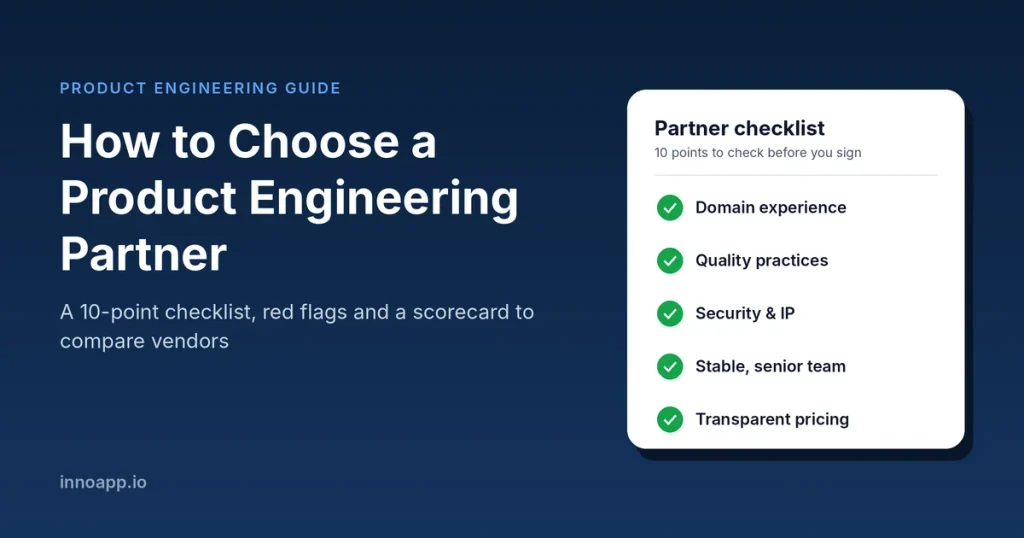
The 10-point checklist for choosing a product engineering partner
Score every shortlisted partner on these ten points. The first five show whether they can build your product; the last five show whether working with them will go smoothly.
Getting this right matters: 70% of executives in Deloitte’s 2024 Global Outsourcing Survey said they had brought some outsourced work back in-house over the past five years.
1. Relevant domain experience
A partner who knows your industry asks better questions and avoids expensive mistakes, especially in regulated fields like automotive, banking or healthcare.
- Check: case studies in your industry and products of similar size and complexity.
- Ask: “Which past project is closest to ours, and what went wrong on it?”
2. Full product lifecycle capability
Handing work between several vendors creates gaps. A strong partner covers discovery, UX, architecture, development, QA, DevOps and support.
- Check: in-house designers, QA engineers and DevOps, not just developers.
- Ask: “Who owns the product from prototype to post-launch support?”
3. Technical depth in your stack
General coding skill is not enough for embedded, IoT, cloud-native or AI work. Look for engineers who have shipped products on your exact technologies.
- Check: architects and senior engineers with hands-on experience in your stack.
- Ask: “How would you design this, and what would you avoid?”
4. Engineering quality practices
Quality comes from process, not promises. Mature teams use code reviews, automated testing and CI/CD by default.
- Check: test coverage targets, release frequency, defect rates and how they use AI tools. Deloitte found 83% of executives already use AI in outsourced services, so ask how it is reviewed and secured.
- Ask: “Can we see a sample pull request, test report and release checklist?”
5. Security, compliance and IP protection
Your code, data and ideas are your most valuable assets. Protect them in the contract and in daily practice.
- Check: ISO 27001 or SOC 2 certification, NDAs, IP assignment to you and compliance with laws like GDPR.
- Ask: “Who will have access to our code and data, and how is that access removed?”
6. Team stability and seniority
A great sales pitch means little if junior engineers do the work, or if key people leave mid-project.
- Check: named team members, the ratio of senior to junior engineers and annual attrition.
- Ask: “Who exactly will work on our product, and what happens if someone leaves?”
7. Communication and project management
Most failed projects are communication failures. You need clear ownership and a steady rhythm.
- Check: a single point of contact, agreed overlap hours, weekly demos and shared tools like Jira and Slack.
- Ask: “What will a normal week of updates and meetings look like?”
8. Transparent pricing and flexible engagement
Cheap quotes often hide costs that appear later as change requests.
- Check: a clear rate card, a detailed statement of work and a written change-request process.
- Ask: “Which costs are not in this quote?”
9. Proven track record and references
Past clients are the best predictor of how a partner will treat you.
- Check: independent reviews and two or three reference calls with clients you choose from their list.
- Ask references: “Would you hire them again, and what would you do differently?”
10. Long-term support and a clean exit plan
Your product will need updates for years. You also need a way out if the partnership ends.
- Check: support SLAs, maintenance plans, documentation standards and a handover clause.
- Ask: “If we move the product in-house in two years, how does the handover work?”
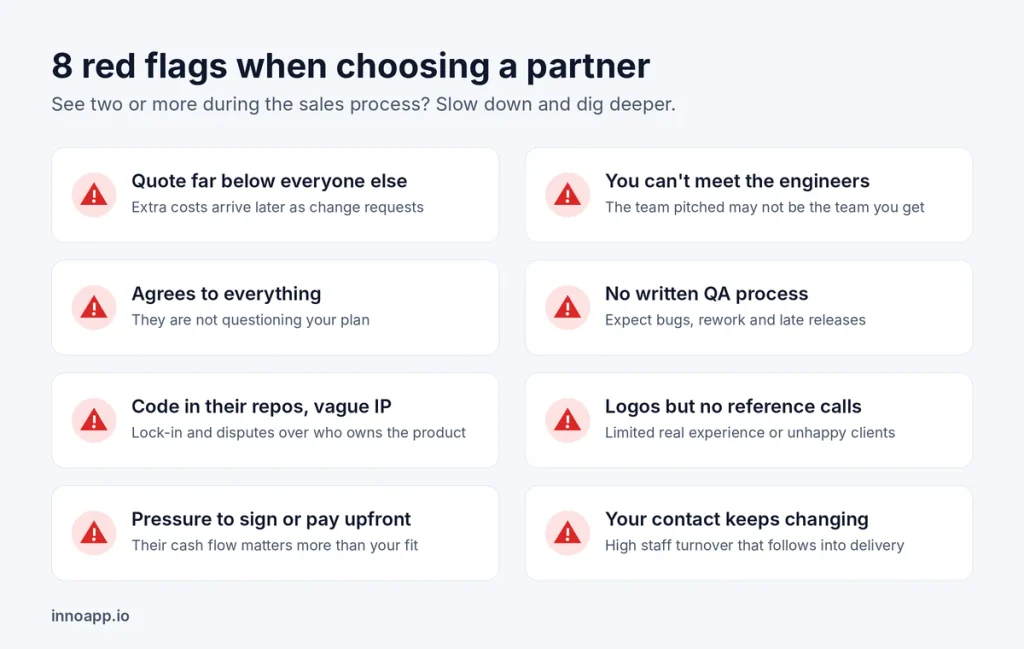
Red flags to watch for
If you see two or more of these during the sales process, slow down and dig deeper.
| Red flag | What it usually means |
|---|---|
| The quote is far below everyone else’s | The scope is underestimated or juniors will do the work; extra costs arrive later as change requests |
| You can’t meet the engineers before signing | The team you were pitched may not be the team you get |
| They agree to everything and ask few questions | They are not thinking critically about your product |
| No written QA or testing process | Expect bugs, rework and delayed releases |
| Code stays in their repositories and the IP clause is vague | Lock-in and possible disputes over who owns the product |
| Only logos, no reference calls | Limited real experience or unhappy past clients |
| Pressure to sign fast or pay a large amount upfront | Their cash flow matters more than fit |
| Your contact person keeps changing during sales | High staff turnover that will follow into delivery |
A scorecard to compare partners
A weighted scorecard stops the lowest price or the best sales pitch from deciding for you. Score each partner from 1 (poor) to 5 (excellent) on every point, multiply by the weight and add up the results.
In the example below, Partner A sent the lowest quote but scores 3.75. Partner B costs more but scores 4.40, mainly on quality and security.
| Criterion | Weight | Partner A (example) | Partner B (example) |
|---|---|---|---|
| 1. Domain experience | 15% | 4 | 5 |
| 2. Full lifecycle capability | 10% | 4 | 4 |
| 3. Technical depth | 15% | 4 | 4 |
| 4. Engineering quality | 15% | 3 | 5 |
| 5. Security and IP | 10% | 4 | 5 |
| 6. Team stability | 10% | 3 | 4 |
| 7. Communication | 10% | 4 | 4 |
| 8. Pricing transparency | 5% | 5 | 3 |
| 9. Track record | 5% | 4 | 5 |
| 10. Support and exit plan | 5% | 3 | 4 |
| Weighted score (out of 5) | 100% | 3.75 | 4.40 |
Adjust the weights to fit your product. A medical or automotive product might give security and compliance 20%, while an early MVP might weight speed and cost higher. As a rule of thumb, shortlist partners who score 4.0 or more.
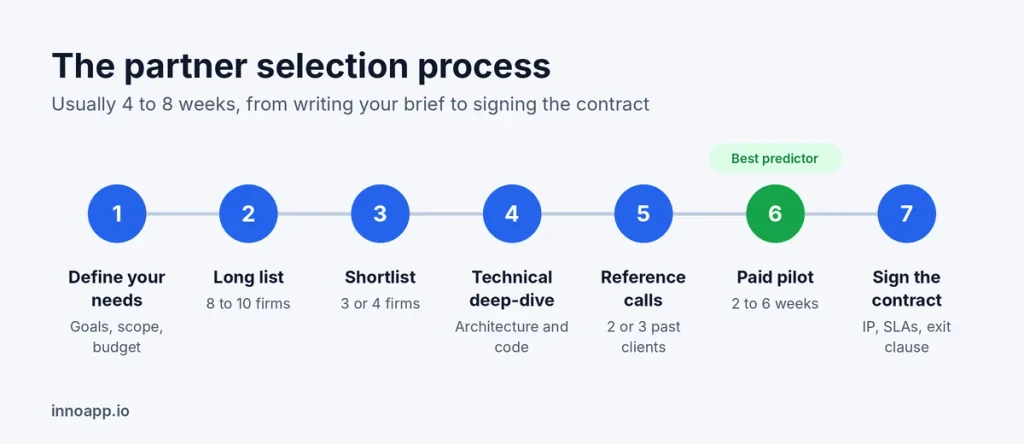
The selection process, step by step
A careful selection usually takes 4 to 8 weeks. That is far less than the months you lose fixing a bad choice.
- Define what you need. Write down your goals, scope, budget, timeline and the skills you cannot do without.
- Build a long list of 8 to 10 firms. Use referrals, review sites, LinkedIn and industry events.
- Send a short brief and shortlist 3 or 4. Drop anyone whose answers are generic or who asks no questions.
- Hold a technical deep-dive. Ask their architects to sketch a solution and walk you through real code and test reports.
- Call references. Speak with two or three past clients, ideally in your industry.
- Run a paid pilot with your top one or two. A 2 to 6 week pilot on a real feature shows how the team actually works.
- Agree the contract. Lock in the statement of work, IP ownership, security terms, SLAs and an exit clause before full kickoff.
How InnoApp measures up
InnoApp Software Systems is a product engineering company based in Chennai, India. We built our model around the points on this checklist.
- Domain experience: we work with enterprises in manufacturing, automotive, semiconductor, retail, telecom and BFSI.
- Full lifecycle: architecture, design, development, QA and ongoing support under one roof.
- Technical depth: mobile, web, enterprise, embedded, IoT and cloud engineering, plus business applications such as ERP and CRM.
- Direct access to engineers: no layers of account managers between you and the people building your product.
[Add before publishing]: InnoApp’s security certifications (if any), typical team setup and one short client result.
Want to run InnoApp through this checklist? Book a call with our engineering team and ask us every question on it.
FAQs
What should I look for in a product engineering partner?
Look for domain experience, full lifecycle capability, depth in your tech stack, strong quality practices, security and IP protection, a stable senior team, clear communication, transparent pricing, good references and a clear support and exit plan.
What questions should I ask a software development company before hiring?
Ask who exactly will work on your product, which past project is closest to yours, how they test and release code, who owns the IP, which costs are not in the quote and how a handover would work.
How many partners should I shortlist?
Start with 8 to 10 names, then shortlist 3 or 4 for detailed evaluation. Run a paid pilot with your top one or two.
Should I choose the cheapest product engineering company?
Rarely. The lowest quote often leaves out work that later returns as change requests, or relies on junior engineers. Compare partners on weighted scores, not price alone.
Is a paid pilot worth the cost?
Yes. A 2 to 6 week pilot on a real feature is the most reliable way to see code quality, communication and speed before you commit to a long contract.
How long does it take to choose a product engineering partner?
Usually 4 to 8 weeks, from writing your brief to signing the contract.